Market size is a range.
Nine publishers put the 2025 PIM market at about USD 16–21 billion. Forecasts for 2030–2035 run from USD 35 billion to USD 121 billion. The gap is scope and compounding.
Each page is the written draft in the report layout. Click a page to enlarge it. Write on the pages you want changed. Empty boxes are left out. At the end, create the summary and copy it, then paste it back into the chat. Comments stay in this browser until you clear them.
1 Front cover
PIM Landscape, Market Trends and Comprehensive Guide
www.pimvendors.com · report@pimvendors.com
This page is longer than A4. The words are all here. The print page would need a cut.
Locked cover copy from the content pack. Contact line is part of the cover, not a finding.
5 Text page
Who publishes it, what the facts are worth, and what this report refuses to do.
PIMvendors.com B.V. publishes the PIM Report 2027. This edition is dated December 2026. Research closed on 17 October 2026, except where a page states a later access date.
PIMvendors.com is an independent PIM advisory. We do not rank vendors. Inclusion in this report is not an endorsement.
Vendor statements are reported as vendor claims. Summaries of regulation are not legal advice. Market sizes are estimates published by other firms, and they do not agree with each other. Where we draw a conclusion of our own, the page says so.
This page is longer than A4. The words are all here. The print page would need a cut.
Print month is December 2026 per PAGE-PLAN (set at print). The sentence 'No vendor paid to be included' is an open decision (PLAN section 6) and is not in the body. No referral disclosures (DECISIONS 1). No ISBN until one is assigned.
2 Contents
This page is longer than A4. The words are all here. The print page would need a cut.
Page numbers are filled at build from PAGE-PLAN order after case pages are pruned. Order follows the book, so Buying appears twice. Chapter lines are the locked deks.
5 Text page
We checked the 2025 report, removed what we could not defend, and rebuilt the book around what a buyer can verify.
The last edition did not survive a check, so this one was rebuilt.
We tested 47 figures, dates and named studies in the 2025 report. Eight were still right. Thirteen were out of date. Seven did not match the source they were attached to. One was false. Eighteen could not be traced at all. We cut or replaced the claims we could not defend (our check, 2026).
The market moved while we were checking. AI shopping channels now publish the product fields an assistant needs. Five of the 28 vendors we checked document an MCP server as generally available, so an assistant can read and change the catalogue within the rights the vendor allows (our count, October 2026).
Ownership moved too. Salesforce bought Informatica. Dassault Systèmes, through Centric, bought Contentserv. Cinven took control of Salsify, and Tenzing of Pimcore. Both of those last two deals were still completing when we researched them. This report treats them as closed.
This edition adds what the last one lacked: what vendors have actually shipped in AI, agentic commerce, a regulation timeline, cost and implementation, the Benelux and DACH markets, a buyer checklist, a glossary, and 40 vendor profiles, twelve more than in 2025. We do not rank those vendors. A profile is a set of sourced facts. It is not a recommendation.
Facts in this book were closed on 17 October 2026, unless a page names a later date.
Stephan Spijkers and Chris Jobse
PIMvendors.com
Cited in the file, not printed as codes: R05, R04, R07, R08
This page is longer than A4. The words are all here. The print page would need a cut.
Draft for Stephan Spijkers and Chris Jobse to sign or rewrite. The 47-claim confession is the trust the rest of the book spends. Counts match R05 after the rerun: 8 verified, 13 outdated, 7 misquoted, 1 false, 18 unverifiable. MCP count is five of 28 vendors checked, not five of the 40 profiled. Salsify/Cinven and Pimcore/Tenzing are written as closed per DECISIONS 4, without a completion date.
4 Key findings
The results first. The limits sit in the same sentence as the result.
Nine publishers put the 2025 PIM market at about USD 16–21 billion. Forecasts for 2030–2035 run from USD 35 billion to USD 121 billion. The gap is scope and compounding.
Of 28 vendors checked, ten document generative copy as generally available and nine document translation. Agents are generally available at three, and in beta at three more. No vendor documents EU data residency.
Five vendors document an MCP server as generally available: Akeneo, Bluestone, inriver, Sales Layer and Stibo. Pimcore documents one in beta. The servers let an assistant read and change the catalogue inside the permissions the vendor sets.
OpenAI's product feed, Google Merchant Center, Google UCP and schema.org all require an identifier, a title, an image, a price and availability. GTIN and MPN decide whether a product can be matched.
AI-referred visits to US retailers grew 393% year on year in the first quarter of 2026, and 62% in July 2026. They stay under 1% of traffic. No European figure was found.
Cited in the file, not printed as codes: R06, R04, R08
This page is longer than A4. The words are all here. The print page would need a cut.
Findings 1–5. Denominator is 28 vendors checked, not the 40 profiled. Finding 5 has no EU figure.
4 Key findings
From 18 February 2027 every battery needs a QR code. Electric-vehicle, light-transport and industrial batteries need a passport. Most other product passports are not in force yet. Those rules are still being written.
GS1 wants retail checkouts to read 2D barcodes by the end of 2027. In May 2026 Carrefour had more than 50 products with a GS1 QR code, against an earlier plan of 2,000.
In 2025 and 2026 Salesforce bought Informatica, SAP bought Reltio, and Dassault Systèmes bought Contentserv through Centric. Cinven took control of Salsify, and Tenzing of Pimcore. We treat those two deals as closed.
Four of the 28 vendors in the 2025 edition publish a list price. Entry tiers cover 500 to 50,000 SKUs, so the prices do not compare. For a large rollout, vendors claim 6 to 18 months.
That range is PIMvendors guidance, drawn from our experience. It is not a measured study. No independent failure rate or total-cost benchmark for PIM exists. Figures vendors publish about cost are claims.
Cited in the file, not printed as codes: R10, R11, R07, R13
This page is longer than A4. The words are all here. The print page would need a cut.
Findings 6–10. Finding 9 is implementation time, a vendor claim, and is not the payback in finding 10. Finding 10 is PIMvendors guidance (DECISIONS 2). Salsify and Pimcore deals are treated as closed (DECISIONS 4).
5 Text page
Every number has a status. The status tells you whether you can take it into a board pack.
Vendor claim. The number comes from the vendor, or from a survey the vendor commissioned. We have not checked it against the customer's books. Quote it as the vendor's claim, or leave it out.
Unconfirmed. The fact was published, and we could not confirm it on a primary source. It stays visible so the gap is on the page. It is not a finding you should repeat as settled.
High, medium, low. High means a primary source, read recently. Medium means a solid secondary source, or a primary source older than twelve months. Low means one weak source. An inference is labelled Our reading, and it is separate from all three.
Sources are named by author and year. The full entry, with the address and the date we read it, is at the back of the book.
Vendor order is alphabetical. A position in the landscape follows two rules we state there: the segment the vendor sells to, and the step in the value chain it names. Neither is a score.
Dates are written the European way: 18 February 2027.
This page is longer than A4. The words are all here. The print page would need a cut.
Definitions of confidence match CLAUDE.md rule 4. No new facts.
3 Chapter opener
The product record, the journey it takes, and the line between what every PIM must do and what some add.
This page is longer than A4. The words are all here. The print page would need a cut.
Opener only. The argument is developed on the next three pages.
5 Text page
A PIM is where the product information you sell with is managed, enriched and published.
Same facts. A different shape for each channel.
A PIM is the system in which a company manages, enriches and publishes the product information it sells with, for every channel. That is our definition. A 2026 analyst landscape, quoted on a vendor site, describes the same job as a hub that manages, enriches and syndicates product data (novomind 2026).
The record is not the price book and it is not the file store. It is the set of facts a channel needs in order to accept the product, and the selling copy that sits on those facts. ERP still owns stock and the invoice. A DAM still owns the image file and the rights on it. The PIM owns the version of the product that a shop, a marketplace, a catalogue or an assistant will show.
The record moves through three stages. Onboarding brings in what the company already knows: the item from the ERP, the specification from suppliers, the design data from a PLM. Enrichment turns that into something a buyer can use: marketing copy, assets, translations and a classification. Publishing sends a shaped version to the web, to marketplaces, to print and, from this edition, to AI channels. The diagram on this page is that path. Adding AI channels as an endpoint is our reading of where product data now has to land. The three stages themselves are the working model of this report.
A useful record holds six kinds of fact.
Two channels can need different slices of that record. They should not need two different truths. When colour, material or the product name differs between the shop and the marketplace, the PIM has not done the job, however many connectors it lists.
Cited in the file, not printed as codes: R12 S59
This page is longer than A4. The words are all here. The print page would need a cut.
The Market Guide sentence in R12 S54 is held back until citation approval. The analyst-landscape line uses only the vendor quotation in R12 S59, so the page cites novomind 2026.
5 Text page
The word PIM covers a core job and a long menu. Ask which one you are being sold.
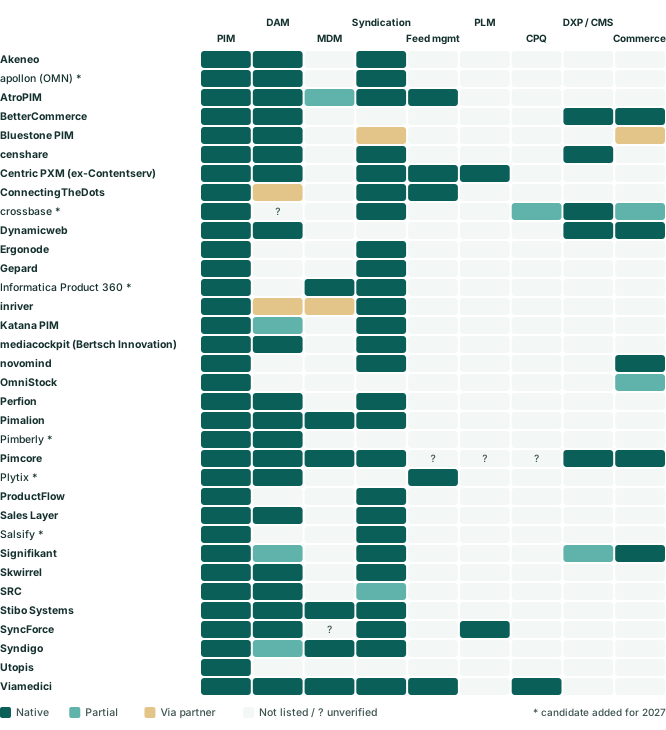
Every product that calls itself a PIM should do the same underlying work. The modules around that work are a choice, and vendors make it differently. Chapter 07 shows how the vendors in this report describe their own modules. The split below is ours, so you can read that chart against a fixed list.
Every PIM should do these.
Some PIMs also offer these.
Treat the second list as a set of questions, not as a score. A vendor that stops at the first list can be the right buy. A vendor that advertises the whole of the second list still has to show which items are in the product you would licence, and which are a partner, a beta, or an extra contract.
Cited in the file, not printed as codes: R12
This page is longer than A4. The words are all here. The print page would need a cut.
Lists are our wording, aligned to chart C08. C08 is printed in chapter 07. This page only points to it. No analyst firm is named.
5 Text page
Most name more than one step in the chain. That is a description of their market, not a count of their customers.
Of the 28 vendors in the 2025 edition, 21 name manufacturers as an audience, 19 name wholesale or distribution, and 23 name retail or brands. Thirteen name all three. The source is each vendor's profile in the PIMvendors directory, read on 10 October 2026, and the confidence is medium. The text is partly the vendor's own positioning and partly our summary of it. It says who the vendor claims to serve. It does not say who pays them.
A handful describe a narrower market. Signifikant and SyncForce name manufacturing only. BetterCommerce and Ergonode name retail and brands only. OmniStock and ProductFlow name wholesale and retail, and not manufacturing. Utopis names manufacturing and wholesale, and not retail. Broad or narrow is a fact about the page they publish. It is not a judgement of the product.
The work itself differs by step, even when the software category is the same.
Manufacturers live in technical data. A buyer, and often a standard such as ETIM, wants the specification to be complete and stable. The selling text is secondary to the attribute that a distributor will map.
Wholesalers live in other people's data, arriving in volume. The hard part is onboarding suppliers, mapping their attributes onto one model, and sending a clean record onward. A portal and an import matter here more than a campaign headline.
Retailers and brands live in the channel. The same product needs a different shape for the shop, the marketplace and the print piece, and the facts underneath those shapes have to stay the same. Content per channel is the job. A missing required field is a rejected listing, not a style choice.
If you are in one of these steps, start with the vendors that name it. Then test the claim. A logo strip is not a customer base, and a sentence that says "for retail" is not a reference.
Cited in the file, not printed as codes: R17
This page is longer than A4. The words are all here. The print page would need a cut.
Counts are the 28 vendors of the 2025 edition, from directory text accessed 10 October 2026, not the 40 in this edition. Confidence medium. Naming the narrower vendors is a scope fact from R17, in the order the research states, with no quality adjective.
3 Chapter opener
Five ways a spreadsheet runs out, and what poor product data actually costs.
This page is longer than A4. The words are all here. The print page would need a cut.
Dek is ours, within the chapter brief. The 2025 edition had no usable dek once its statistics were removed.
5 Text page
The pressures are familiar. The figures from the last edition are not reused, because they did not survive a check.
Five pressures show up in almost every selection project. The 2025 edition attached a statistic to each of them. Those statistics are gone. What remains is the pressure, plus the facts we can still source.
The catalogue gets too complex to pass by hand. Variants, packs, seasons and languages multiply the rows. A spreadsheet can hold them while one person knows which file is current. It stops being a system when two people edit it, or when a launch depends on a column nobody owns. We have no sourced count of how many SKUs tip a company over. The signal is operational: people keep a second list because the first one is no longer trusted.
Conversion depends on the record being complete. A channel that rejects a file, or a shopper who cannot find the specification, is a commercial problem with a data cause. The popular percentages for cart abandonment and conversion uplift did not trace to a source we can print. Chapter 02's next page keeps the only consumer figures that did.
Channels stop accepting free text. In 2025, 56.7% of German online sales went through marketplaces (HDE 2026). bol requires an EAN and declines an upload without one. OTTO requires an EAN on new products. Kaufland requires an EAN, and has required image alt text since June 2025. Zalando publishes detailed attribute rules, but the EAN rule itself was not on the public pages we could read, so we do not state it. From 31 January 2027, Google Merchant Center will enforce a minimum image of 500 by 500 pixels (Google 2026). A PIM earns its place when those rules live on the record, and a publish fails before the channel does.
Borders add fields, not just languages. Since 13 December 2024 the General Product Safety Regulation has required, on distance sales, the manufacturer's name and address, an EU responsible person where the manufacturer is outside the Union, a product identifier, and warnings (European Union 2023). Every channel that offers the product has to show them. A translation memory does not collect a field you never stored.
Returns close the loop. Wrong or thin product information is one reason goods come back. It is not, on the evidence we have, a ranked cause. The next page says what can be said about the cost, and what cannot.
Cited in the file, not printed as codes: R15 S04, R15 S08, R15 S14, R15 S16, R15 S12, R08 S22, R10 S20
This page is longer than A4. The words are all here. The print page would need a cut.
Content pack says all four marketplaces require an EAN/GTIN. R15 findings say Zalando's EAN rule was NOT FOUND on the public pages. This page follows R15. White-background rules are in R15 and are not needed for the argument, so they are left out.
5 Text page
The usable figures come from vendor surveys and from one retail returns report. Read them as such.
Vendor surveys measure a vendor's question. They are not an independent cost of poor PIM data.
Buyers ask what bad product data costs. The honest answer is that almost every widely quoted number failed a source check. Four findings are solid enough to print, and each one carries a limit.
Akeneo reports that 65% of consumers would abandon a purchase when product information is lacking, and that 40% returned a product because the information they saw before buying was inaccurate (Akeneo 2026). Both figures are a vendor claim. We have them from a secondary report of 31 March 2026, not from a method note we read ourselves. They describe shoppers answering a vendor's survey. They do not describe your return rate.
Syndigo, with YouGov, surveyed 8,736 consumers in June 2026 and reports that 80% say inaccurate content damages the brand (Syndigo 2026). That is also a vendor claim. The same survey is described as showing shoppers more likely to buy what an AI recommends, but Syndigo's own page and a secondary report disagree between 25% and 26%. Until the press release is checked, this book does not print that figure.
The US National Retail Federation, with Appriss Retail, reported that US returns in 2023 were USD 743 billion, 14.5% of sales, and 17.6% for online sales (NRF 2023). The source gives no ranking of why goods come back. We do not treat product information as a measured cause of those returns. The year is 2023. Treat it as scale, not as a current rate.
Put the four findings side by side and the pattern is the finding. Consumer pain is documented by companies that sell the remedy. The one independent retail figure does not connect the returns to product content. An independent study that measures the cost of poor product data for PIM was not found.
Count the cost in your own operation. Rejected marketplace feeds, tickets marked "not as described", and the hours spent reconciling two descriptions of one SKU are evidence you can audit. A percentage from a vendor's survey is a prompt to go and look. It is not the look.
Cited in the file, not printed as codes: R05 S2, R05 S28, R09 S9, R14 S37, R14 S38, R14
This page is longer than A4. The words are all here. The print page would need a cut.
Akeneo 65% and 40% are a vendor survey reported by CFOtech on 31 March 2026. Akeneo's own release was not read (R05 S2, medium). Other figures in that article (17% return rate, USD 900bn, 70%) are not in the allowed list and are omitted. Syndigo 25% versus 26% is unresolved, so the likelihood figure is not printed. NRF is December 2023 and is labelled with its year. Do not rank product information among the causes of those returns.
3 Chapter opener
Every publisher agrees the market grows. They disagree on almost everything else, and the reasons matter.
This page is longer than A4. The words are all here. The print page would need a cut.
Opener only.
6 Chart page
Forecasts for 2030–2035 run from USD 35 billion to USD 121 billion.
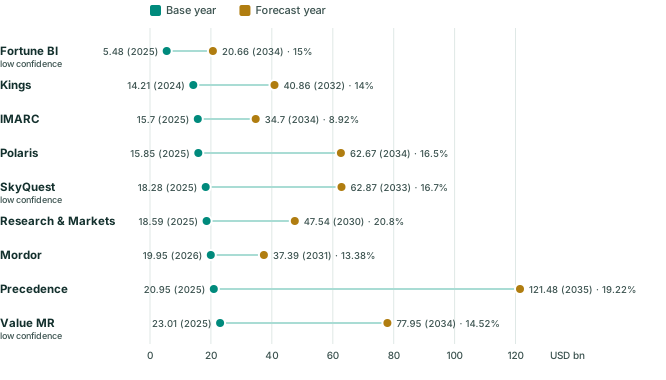
Nine publishers released forecasts in 2025 and 2026. Their base values for 2025 run from USD 15.7 billion (IMARC) to USD 23.0 billion (Value Market Research). Fortune Business Insights, at USD 5.5 billion, sits apart. Our reading is that Fortune counts a narrower scope.
Mordor's published base is for 2026, at USD 19.95 billion, so it sits in the set and outside that 2025 span. Value Market Research was read from a reseller listing, not from the publisher's own page, so the upper figure in that range is low confidence.
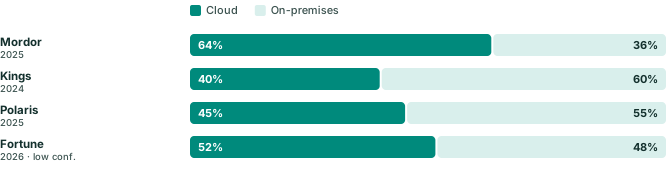
Under the chart, cloud and on-premises do not agree either. Mordor puts cloud at 63.5% of 2025 revenue. Kings puts on-premises at 59.94% in 2024, and Polaris at 54.61% in 2025. All of them say cloud is the fastest-growing deployment, at about 18–19% a year (Mordor 2026; Kings 2026; Polaris 2026).
Cited in the file, not printed as codes: R06 S1, R06 S2, R06 S3, R06 S4, R06 S5, R06 S6, R06 S7, R06 S23, R06 S24
This page is longer than A4. The words are all here. The print page would need a cut.
Lead is capped at 60 words. Fortune outlier is labelled as our reading. Do not average the publishers. F1 fix on this page is a build task, not a copy task. Publication dates for Mordor, Value Market Research and SkyQuest still need a check on the publishers' own pages before print.
5 Text page
Publishers can name a largest region. They cannot yet describe Europe with a figure we would repeat.
Europe is under-measured. That is a finding, not a missing footnote.
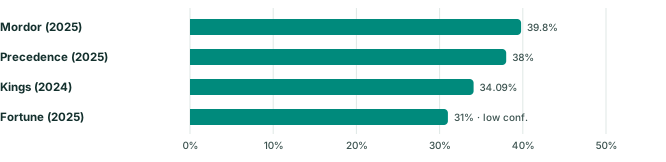
North America is the largest region in most of these reports, and the share depends on who is counting. Mordor puts it at 39.8% of 2025 revenue. Precedence puts it at 38% for 2025. Kings puts it at 34.09% for 2024. Fortune puts it at 31%, on a base so far below the others that the share is low confidence (Mordor 2026; Precedence 2026; Kings 2026; Fortune 2026).
Polaris is the exception. It names Asia Pacific first, at 35.47% in 2025 (Polaris 2026). Asia Pacific is also the region most publishers call the fastest growing: 20.1% a year at Mordor, 15.06% a year at Kings.
Europe is the gap. Fortune is the only publisher in this set that gives Europe a share, 29%, and Fortune is the low-confidence outlier. Everyone else describes Europe in words or leaves it out. If you need a European number for a board, you do not have one that this report will stand behind. The Benelux and DACH chapter later in the book uses retail and marketplace facts instead of a share of a global software market.
Company size is more consistent, and still not identical. Large enterprises hold 68.8% of the market in Mordor's 2025 cut, 53.27% in Polaris, and 54.72% in Fortune's 2026 cut. Mordor says smaller firms are growing fastest, at 18.43% a year (Mordor 2026; Polaris 2026; Fortune 2026).
By industry, Mordor names retail and e-commerce as the largest slice, at 33.2%, and IT and telecom as the fastest growing, at 19.5% a year (Mordor 2026). Other publishers do not line up on the same industry list closely enough to merge. We do not merge them.
Read a chart of regions as a set of publisher decisions about scope. A company selling in Germany is not 29% of a global total, and a forecast will not tell it so.
Cited in the file, not printed as codes: R06 S2, R06 S3, R06 S4, R06 S5, R06 S6
This page is longer than A4. The words are all here. The print page would need a cut.
Europe share is Fortune only, low confidence. Grand View's 2023 North America figure is stale and is not used. Shares are printed as published, not rounded into one corridor.
5 Text page
Named company revenues and deal values are a different order of magnitude from a market of tens of billions.
A forecast of tens of billions needs something to stand on. The company figures we can verify are smaller, and they are worth more because of that.
Stibo Systems reported revenue of DKK 1.31 billion for 2025–26, up 6.0%, with software-as-a-service revenue up 17.0% and an EBITDA margin of 18.1% (Stibo Systems 2026). The company sells multidomain master data as well as PIM. The figure is the company's own.
Dassault Systèmes, through Centric, bought Contentserv at an enterprise value of EUR 220 million (Dassault Systèmes 2025). Salesforce bought Informatica for about USD 8 billion in equity value. The deal closed on 18 November 2025. It is a master-data and data-management transaction, not a purchase of a PIM product on its own (Salesforce 2025).
Syndigo described the company that resulted from combining with 1WorldSync as worth more than USD 3.5 billion (Syndigo 2025). That is the company's framing of its own combination, not a price paid for a PIM module.
ComCap, an advisory firm, counted 17 mergers and acquisitions and 21 private placements in this space from January 2024 to March 2026. The median private placement was USD 3.3 million (ComCap 2026). The median is a useful scale for the long tail. It is not a typical price for the platforms named above.
Set Stibo's revenue next to a market reported at about USD 16–21 billion and the gap is the point. Our reading is that the forecasts include implementation, content services and adjacent software, not only PIM licences. A services-heavy definition can be the right description of what a buyer spends. It is the wrong description of what a vendor invoices for the product.
Current recurring revenue for Akeneo, Pimcore, inriver and Salsify was not found in a source we will print. Older aggregator figures stay out.
Cited in the file, not printed as codes: R06 S17, R06 S15, R07 S8, R06 S13, R06 S25, R07 S11, R07 S12, R06 S16, R07 S14, R06 S19
This page is longer than A4. The words are all here. The print page would need a cut.
No currency conversion of Stibo's kroner. Salsify's 2021 ARR is stale and is not printed. Akeneo, Pimcore and inriver ARR from aggregators are rejected and not printed. ComCap's own market-size line repeats Mordor and is not used as a forecast.
5 Text page
A growing market tells you the category is not a fad. It does not tell you what to budget.
Direction is usable. A number copied into a business case is not.
A growing category means the shortlist will stay crowded, and that owners will keep changing. Chapter 09 records who bought whom. Choice and consolidation are the same fact seen from the buyer's side of the table: more logos, fewer independent ones.
Cloud is the deployment publishers say is growing fastest. That matches how vendors now package the product. Our reading of the pricing and release evidence is that new vendors and new releases are software-as-a-service first (see chapters 04 and 08). An on-premises option still exists at some of them. It is no longer the story the forecasts are telling.
None of the nine publishers gives a cost per SKU or a cost per user. A forecast cannot be turned into a licence budget by dividing it by a count of companies, because the publishers do not share a definition of the company or of the spend. Use the reports to answer a board that asks whether this category is growing. Answer the budget question with quotes, with the internal time you will spend, and with the payback range in chapter 08, which is our guidance and not one of these forecasts.
The public article on pimreport.com about market size in 2026 prints none of these billions. It asks the reader to check what a publisher counted. This chapter is the longer version of that advice, with the ranges filled in and the outliers left visible.
Cited in the file, not printed as codes: R06, R04, R13
This page is longer than A4. The words are all here. The print page would need a cut.
Consistent with pimreport.com article pim-market-size-and-growth-2026, which prints no market figures and tells the reader to check definitions. No contradiction to log. 'Most new vendors and releases are SaaS-first' is the content pack's inference and is labelled.
3 Chapter opener
What vendors have shipped, what is still beta, and what buyers should ask before switching an agent on.
This page is longer than A4. The words are all here. The print page would need a cut.
Vendor names appear only next to documented product facts.
7 Chart page (AI)
Generative copy is generally available at 10 vendors and translation at 9. MCP access is generally available at five. No vendor documents EU data residency for AI.
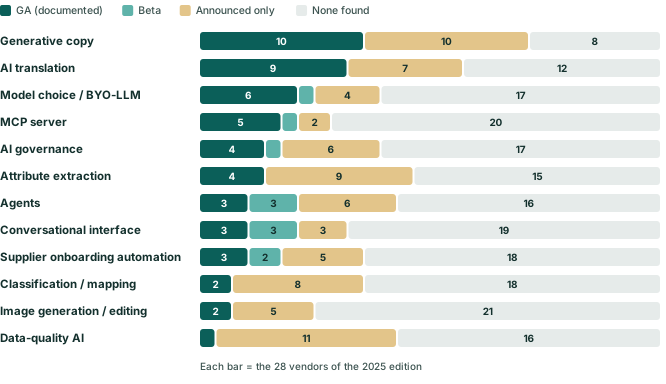
"Generally available" means the vendor's own documentation, help centre, release notes or a dated release says customers can use it. Beta means the vendor labels it so. Announced means marketing only. The count is the 28 vendors of the 2025 edition, read on 13 October 2026. The twelve vendors added in this edition are not in the chart.
Cited in the file, not printed as codes: R04
This page is longer than A4. The words are all here. The print page would need a cut.
Scope is the 28 vendors of the 2025 edition, checked verbatim on 13 October 2026. The 12 vendors added for 2027 are not in C04. Say so on the page until the chart is rebuilt.
5 Text page
The ladder is a way to place your own team. The counts are of vendor documentation, not of your maturity.
Where is your team?
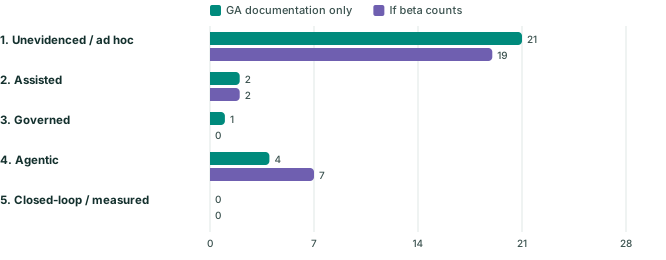
We use five stages. They are our analysis, not a standard.
1. Unevidenced. No embedded AI in the documentation. People paste text into a separate chat tool. There is no policy.
2. Assisted. The product can generate, translate, extract or map, and a person edits each result.
3. Governed. A write waits for approval. The team can choose the model, and prompts and decisions leave an audit trail.
4. Agentic. An agent or an MCP server works on the catalogue inside permissions, with a gate on writes.
5. Closed loop. The agent acts under a policy, and quality or commercial results are measured against a human baseline. No vendor documents this stage.
Counted on generally available documentation only, the 28 vendors sit at 21, 2, 1, 4 and 0. If beta counts, the line is 19, 2, 0, 7 and 0 (our classification, 2026).
A separate, vendor-hosted index of 405 firms found that 13.6% report end-to-end automation with an audit trail (inriver 2025). That is a vendor claim about buyers, not a count of products. Use the ladder to mark where your team is. Do not use it to rank the vendors in chapter 12.
Cited in the file, not printed as codes: R09 S25, R09 S4
This page is longer than A4. The words are all here. The print page would need a cut.
Stages are PIMvendors analysis built on R09. Counts are of 28 vendors. inriver index is vendor-hosted.
5 Text page
The gap is mostly who was asked. Vendor surveys ask people who already buy PIM. Eurostat asks firms.
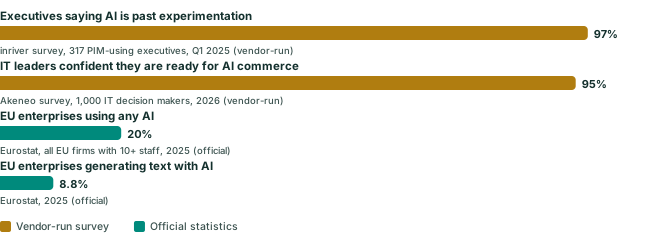
inriver asked 317 executives in the first quarter of 2025. It reports that 97% are past experimentation and that 83% have AI embedded across systems (inriver 2025). The same firm's maturity index, 405 companies, found that 117 claimed full agentic readiness and that none of those 117 met the index's own benchmark. It also reports that 33% keep at least 85% of SKUs ready to publish (inriver 2025). Both are vendor claims.
Akeneo asked 1,000 IT decision makers in the United States and Europe in September 2026. It reports that 95% are confident they are ready for AI-driven commerce, and that 89% spend more than a quarter of each AI project on preparing data (Akeneo 2026). That is a vendor claim. Readiness and data preparation are both in the same survey. The second number is the one that matches what implementation teams describe.
Eurostat, for 2025, reports that 20.0% of EU firms with ten or more staff use any AI, and that 8.8% generate text (Eurostat 2025). A secondary source puts the Netherlands at 33.2% and Germany at 26.0%. Those two country figures are unconfirmed until they are read off the Eurostat table.
The populations do not match, and that is why the headlines do not match. Executives at PIM buyers say AI is already embedded. The official series says most European firms do not use it at all.
What blocks the work, in the order the evidence supports, is data quality and preparation, then trust. inriver's executives report that 90% still see occasional accuracy problems, and that 68% measure trust with indirect indicators (inriver 2025). Cost, skills and the law come after. The legal share is not quantified in these surveys.
Cited in the file, not printed as codes: R09 S1, R09 S2, R09 S3, R09 S4, R09 S5, R09 S7, R09 S8
This page is longer than A4. The words are all here. The print page would need a cut.
NL 33.2% and DE 26.0% are from a secondary source. Pack says take them from the Eurostat table before print. Printed here as unconfirmed. All vendor percentages are vendor-run surveys.
5 Text page
Six vendors document an agent or an MCP server. The questions below are the same for all of them.
These are documented facts, not a ranking. Each one comes from the vendor's own pages.
Akeneo documents Ask Ziggy as generally available since May 2026. Agentic Ziggy is in beta, with an approval plan before a change and enrichment that can be reverted. An MCP server is documented. Whether a given package includes it depends on the edition (Akeneo 2026).
Bluestone documents an MCP server as generally available, including permitted write and destructive operations. Its agent asks for confirmation before a write. The documented model providers are Anthropic, Google and OpenAI (Bluestone 2026).
inriver's spring 2026 release documents Enhance and Expression agents and a visual workflow builder with agent actions. The summer 2026 release documents an Enrich Assistant and a further MCP server (inriver 2026).
Sales Layer documents an AI suite and an MCP server on 11 December 2025, an agents knowledge base on 30 July 2026, and Anthropic as a model provider on 13 August 2026 (Sales Layer 2025; Sales Layer 2026).
Stibo Systems documents an MCP server as generally available in release 2026.2 on 16 June 2026. CoPilot chat is in limited availability in 2026.3. AgentWorkx was announced on 29 September 2026 (Stibo Systems 2026).
Pimcore's Agent Bundle, in release 2026.2, is beta. It documents propose, review and approve for every write (Pimcore 2026).
Put these questions to any vendor, including the six above.
Cited in the file, not printed as codes: R04
This page is longer than A4. The words are all here. The print page would need a cut.
Facts from each vendor's own documentation, R04 per-vendor section, verbatim check 13 October 2026.
5 Text page
High-risk rules in the AI Act moved. The dates that bite on a product page are closer, and they are about claims.
This page is not legal advice.
Regulation (EU) 2026/1744 entered into force on 27 July 2026. High-risk duties now apply from 2 December 2027 for Annex III and from 2 August 2028 for Annex I (European Union 2026).
Article 50, on transparency, has applied since 2 August 2026. Systems already on the market have until 2 December 2026 for machine-readable marking. That grace period is low confidence in our notes (R09).
Our reading, and it is an inference, is that generating, translating, classifying and enriching product data does not fall in the Annex III high-risk categories, so those uses are typically outside the high-risk regime. AI literacy under Article 4 still applies to anyone deploying AI. A secondary account says the duty was softened to taking measures that support literacy. That wording is low confidence until it is read on EUR-Lex.
The rules that change a product page sooner are consumer law. From 27 September 2026, a generic environmental claim without proof is banned (Directive (EU) 2024/825). "Eco", "green" and "climate friendly" need an evidence link or they come off the record.
The new Product Liability Directive covers software and AI for products placed on the market after 9 December 2026 (European Union 2026). A generated description is not outside that only because a model wrote it.
Our reading on copyright: text that is wholly generated is unlikely to be protected in the European Union or the United States, so copy that no person edited can be copied by someone else (inference). Keep a human edit, and a record of who approved it, if the wording has to stay yours.
Cited in the file, not printed as codes: R10 S14, R05 S37, R09 S17, R09 S16, R09 S18, R10 S40, R09 S19, R09 S20, R09 S21
This page is longer than A4. The words are all here. The print page would need a cut.
Article 4 wording is low confidence and was not re-read on EUR-Lex in this pass. DECISIONS 7: high-risk dates rest on R10's reading of the OJ and on law-firm summaries.
3 Chapter opener
AI assistants now shop, compare and sometimes buy. What they need from your product data is surprisingly ordinary.
This page is longer than A4. The words are all here. The print page would need a cut.
5 Text page
As of October 2026, no European date was found for an assistant completing a purchase inside the assistant.
| Platform | Status in October 2026 | Europe and the Netherlands |
|---|---|---|
| ChatGPT shopping | Discovery is shipped. OpenAI's own Instant Checkout was refocused to the merchant's checkout on 24 March 2026. That date is a secondary source. | No agentic checkout date found for the EU. |
| Google AI Mode and UCP | AI Mode is in most countries, including Europe. UCP checkout has been live in the United States since 11 January 2026. | The published sequence is Canada, Australia, then the United Kingdom. The EU is not named. |
| Microsoft Copilot Checkout | Announced on 8 January 2026 for the United States. | Not found. |
| Perplexity | Instant Buy with PayPal, in the United States. | Not found. |
| Amazon | Rufus was renamed Alexa for Shopping on 13 May 2026. | Rufus has been in beta in France and Germany since November 2024. The Netherlands was not found. |
Adyen reports that 25% of Dutch consumers used an AI assistant while shopping in the past year (Adyen 2026). That is a payments firm's survey, medium confidence. It is about research, not about an assistant paying.
Cited in the file, not printed as codes: R08 S48
This page is longer than A4. The words are all here. The print page would need a cut.
OpenAI's own post on the 24 March 2026 checkout change was not read (403). The date is a secondary source. Adyen figure is medium confidence.
6 Chart page
US retailer referrals grew 393% year on year in the first quarter of 2026 and 62% in July 2026. They stay under 1% of visits.
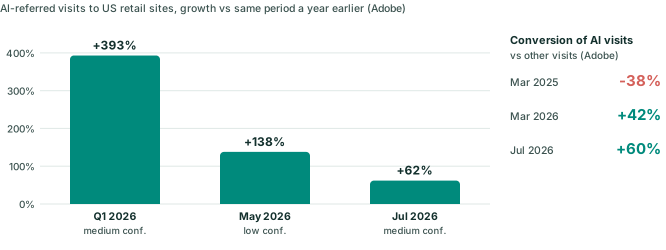
Bain, in November 2025, put AI referrals under 1% of total US retail traffic, and as high as 25% of referrals at some retailers (Bain 2025). Similarweb reports that 11.4% of shopper journeys involve AI, and that most of that influence does not show up as a click (Similarweb 2026). Both are US-weighted. An EU or NL share of traffic was not found.
Cited in the file, not printed as codes: R08 S42, R08 S43, R08 S44, R08 S45
This page is longer than A4. The words are all here. The print page would need a cut.
Adobe, Bain and Similarweb primaries were not all read. Keep the medium and low labels from R08.
6 Chart page
Identifier, title, description, image, price and availability are required everywhere. GTIN and MPN decide whether a product can be matched.
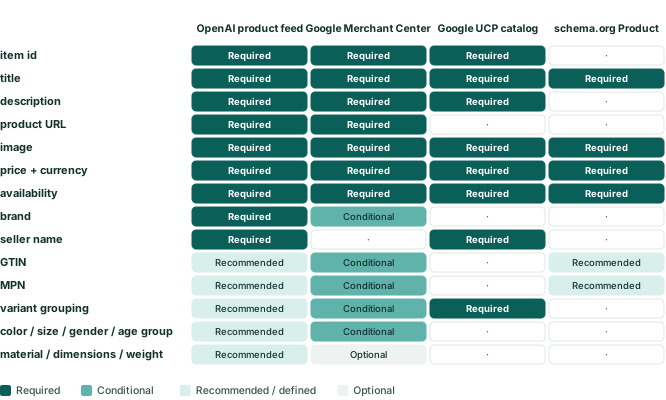
OpenAI's product feed, Google Merchant Center, Google's Universal Commerce Protocol and schema.org ask for the same core. MCP itself defines no commerce attributes (MCP specification 2026). Google says AI Overviews and AI Mode need no special markup beyond ordinary structured data (Google 2026).
A 2023–24 paper on generative engine optimisation reported gains of up to 40% on general queries. It is not about product pages, and it is not a reason to rewrite a catalogue for an assistant.
Cited in the file, not printed as codes: R08 S26, R08 S49, R08 S27
This page is longer than A4. The words are all here. The print page would need a cut.
Do not use the GEO paper's 'up to 40%' as a product-data result. It is 2023-24, general queries, not product-specific.
12 Buyer checklist
Each line is a task for the PIM owner in 2027. The last column is why it is on the list.
Cited in the file, not printed as codes: R08
This page is longer than A4. The words are all here. The print page would need a cut.
Point 5's SLA is our recommendation, an inference from wrong-price risk. Shortened from R08's checklist.
3 Chapter opener
Most EU rules for 2027 are about data you already hold, in places you have not yet published it.
This page is longer than A4. The words are all here. The print page would need a cut.
Not legal advice. Spot-check R10 S16, S19 and S26 on EUR-Lex before print.
8 Regulation timeline
Green Claims stays off this line. It is still a proposal, and it has no date.
Cited in the file, not printed as codes: R10
This page is longer than A4. The words are all here. The print page would need a cut.
Diagram data is outputs/R10/chart-timeline.csv. Rebuild the round-5 figure with this list. Green Claims Directive is a proposal and is omitted.
5 Text page
Several duties are already in force. The product-group passports are not, because the delegated acts are not written.
These duties are live. Distance sales under the General Product Safety Regulation must show the manufacturer, an EU responsible person where the manufacturer is outside the Union, an identifier and warnings (European Union 2023). The European Accessibility Act applies, with an exemption for microenterprise services (European Union 2025). Generic environmental claims without proof are restricted from 27 September 2026 (European Union 2024). CLP pictograms, the signal word and hazard statements belong online for chemical products (European Union 2026). An energy label sits in EPREL and is shown with the price (European Union 2017).
Batteries have the firmest 2027 date. From 18 February 2027 every battery needs a QR code. Electric-vehicle, light-transport and industrial batteries over 2 kWh need a battery passport (European Union 2023). The label date is 18 August 2026 or 18 months after a labelling act, whichever is later. No adopted labelling act was found, so the label is probably later.
No delegated act yet sets the passport attributes for a product group. The working plan points to iron and steel in the fourth quarter of 2026, textiles, aluminium and tyres in the third or fourth quarter of 2027, furniture in 2028 and mattresses in 2029, each with at least 18 months of transition (European Commission 2025). Those are plans, not obligations.
Two regimes are smaller than the 2025 edition implied. CSRD, on a law-firm reading of Directive (EU) 2026/470 that still needs the Official Journal, covers companies with more than 1,000 employees and more than EUR 450 million turnover. CSDDD covers companies with more than 5,000 employees and more than EUR 1.5 billion turnover, from 26 July 2029. Confirm both thresholds on EUR-Lex before you repeat them.
Watch, and do not implement as law: a June 2026 proposal to replace the printed energy label with a QR code and an EPREL number; a pending extension of CBAM downstream; and a Digital Fairness Act expected in the fourth quarter of 2026.
Cited in the file, not printed as codes: R10 S20, R10 S12, R10 S40, R10 S27, R10 S29, R10 S7, R10 S37, R10 S3, R10 S16, R10 S32, R10 S34, R08 S51
This page is longer than A4. The words are all here. The print page would need a cut.
CSRD thresholds are a law-firm source until Directive 2026/470 is read on EUR-Lex (DECISIONS 7, PLAN known issues). Not legal advice.
12 Buyer checklist
Each line has a date. None of them is a full legal memo.
Cited in the file, not printed as codes: R10
This page is longer than A4. The words are all here. The print page would need a cut.
Shortened from R10's must-act list. Point 8 is an inference in the research. Not legal advice. The 71 battery data points were snippet-level and are not repeated as a quota.
5 Text page
A registry and a set of standards exist. The attributes for textiles, furniture and the rest are still unwritten.
Do not write that a digital product passport requires GS1 Digital Link.
The Ecodesign for Sustainable Products Regulation has been in force since 18 July 2024 (European Union 2024). The digital product passport registry went live on 20 July 2026 (European Commission 2026). Implementing Decision (EU) 2026/1736, of 14 July 2026, cites the harmonised standards EN 18216 and EN 18219 to EN 18223 (European Union 2026).
What is not decided is the attribute list for each product group. Those lists sit in delegated acts that have not been adopted. The only passport legally required in 2027 is the battery passport.
The data carrier is a URL that resolves and is globally unique. EN 18219 allows more than one syntax. GS1 Digital Link is one permitted option. Some readers of the standard recommend it. The standard does not mandate it. A page that says the passport requires GS1 Digital Link is wrong.
The practical step is ours, and it is an inference from the texts above. Give each product a unique identifier, name the operator and name the facility. When a delegated act arrives, those three identifiers are what the new attributes will hang from.
Cited in the file, not printed as codes: R05 S16, R10 S3, R11 S15, R05 S35, R05 S36, R11 S33
This page is longer than A4. The words are all here. The print page would need a cut.
EN 18219 allows several syntaxes. GS1 Digital Link is one option, low confidence that it is recommended, and it is not mandated.
6 Chart page
GS1 wants retail point of sale to read the GTIN from 1D and 2D codes by the end of 2027. The target is voluntary.
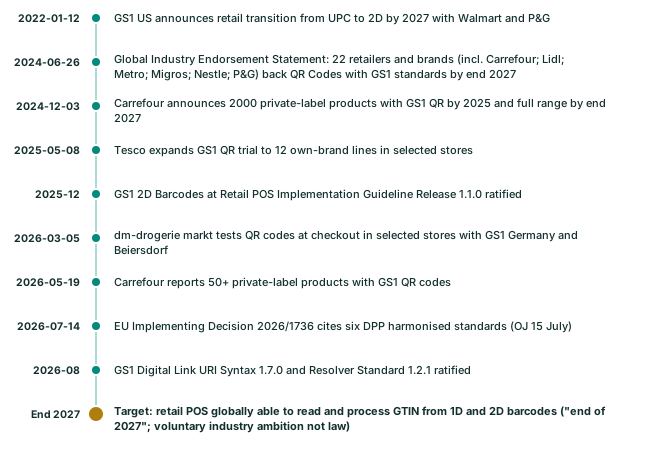
Guideline 1.1.0, December 2025, is the text. From 2028 the brand owner chooses the carrier. Dual marking continues until point-of-sale readiness is high, in the range of 90–95% (GS1 2025). No current measurement of that readiness was found. The last widely cited figure is from 2021 and is stale, so it is not printed.
In the Netherlands, GS1 and Albert Heijn expect Dutch checkouts to be ready by the end of 2027. GS1 Nederland lists more than 30 Dutch retailers as involved. Involvement is not the same as a scanner that works. No statement was found for Jumbo, Lidl in the Netherlands, or the Ahold Delhaize group.
Related standards, separate from the checkout target: GS1 Digital Link URI syntax 1.7.0 and Resolver 1.2.1, August 2026, medium confidence. GDSN 3.1.35 went live on 16 May 2026. ETIM 11.0 is final on 1 December 2026.
Cited in the file, not printed as codes: R11 S3, R11 S19, R11 S27, R11 S6, R11 S25, R11 S32, R11 S28, R11 S30
This page is longer than A4. The words are all here. The print page would need a cut.
Measured POS readiness: none current. VDC 2021 is stale and not used as a rate. Jumbo, Lidl NL and Ahold Delhaize group: no statement found. Digital Link URI 1.7.0 and Resolver 1.2.1 are medium confidence.
12 Buyer checklist
Sunrise preparation for a PIM team. Step 5 is our recommendation, not a GS1 rule.
Cited in the file, not printed as codes: R11
This page is longer than A4. The words are all here. The print page would need a cut.
Step 5 is an inference. Shortened from R11's checklist.
3 Chapter opener
Where PIM ends and DAM, MDM, PLM and commerce begin, and why the lines are blurring.
This page is longer than A4. The words are all here. The print page would need a cut.
5 Text page
Use the job, not the acronym, when a vendor says it does all of them.
| Label | Working definition in this report | Confidence |
|---|---|---|
| PIM | The hub where product data is managed, enriched and syndicated to channels. | Medium. A 2026 analyst landscape, quoted on a vendor site, uses that framing (novomind 2026). |
| DAM | A governed library for files, rights and renditions. The PIM should point at the file. | Low. Analyst glossary pages were not readable. Vendor descriptions only. |
| MDM | Shared master data across domains, such as product, customer, supplier and location, with stewardship. | Medium. The depth behind the label varies. |
| PXM | PIM plus syndication, analytics or personalisation. IDC evaluates PXM and "PIM+" as separate groups. | Low. IDC's own split is gated. |
| Feed management | Formatting and delivering product data to marketplaces and shopping channels. | Low. Vendor self-description. |
| CPQ | Rules for configuration, price and quote on complex products. | Low. Secondary sources only. |
The definitions disagree in three places.
PIM can mean the content hub for channels, or the product master for the company. A vendor that says "we do MDM" may mean a deep multi-domain system or a product record with a workflow. Ask which domains have a golden record.
PXM may be a separate category. IDC treats PXM and PIM+ as different evaluation groups (IDC 2025). The public Forrester material we could read does not define PXM as its own market. Our compare pages, and this report, treat PXM as PIM plus a claim to test.
MDM, when the word is used strictly, covers more than product. Product content for selling can live in a PIM while customer and supplier masters live elsewhere. Mid-market firms often let the PIM act as the commerce product master and skip a separate MDM. That can be right. It is not the same as buying both.
Cited in the file, not printed as codes: R12 S59, R12 S60, R12 S66, R12 S58
This page is longer than A4. The words are all here. The print page would need a cut.
Glossary wording from a gated firm is not printed. IDC's own definition of the PXM versus PIM+ split was not found. Confidence on DAM and feed definitions is low.
6 Chart page
Of the 28 vendors in the 2025 edition, 22 name syndication and 17 name DAM. Five name MDM. Four name feed management. Two name PLM. One names CPQ.
The chart counts modules the vendor names as native. PIM is 28 of 28. Syndication is 22. DAM is 17. MDM is 5. Feed management is 4. Commerce is 5. DXP or CMS is 4. PLM is 2. CPQ is 1. The twelve vendors added in this edition are not in these counts.
Cited in the file, not printed as codes: R12
This page is longer than A4. The words are all here. The print page would need a cut.
Counts are the 28 of 2025, not the 40. Rebuild C08 when the new vendors are checked. Widest named suites: Viamedici, Pimcore, Centric, 5 or 6 of 9. Nine vendors show only 1 or 2 modules. Commerce 5, DXP/CMS 4.
5 Text page
The lean depends on what you already run, not on which logo is larger.
| Your situation | Leans toward one suite | Leans toward a separate PIM |
|---|---|---|
| One team owns product data, media and publishing, and IT is small | A PIM with DAM and publishing in one contract | |
| A DAM is already in use | Link the PIM to that DAM by reference | |
| Customer, supplier and location also need a golden record | Sequence MDM and PIM. Do not pretend one licence did both | |
| Products are engineered or configurable | Check who owns PLM and CPQ first. PLM keeps the design truth. PIM starts at commercialisation | CPQ is rarely native. Plan the integration |
| The commerce stack is composable | Keep PIM apart from the commerce engine, and connect them | |
| Sales are marketplace-heavy | Check native syndication and feed depth. Only 4 of 28 vendors name feed management as native | A specialist feed tool beside the PIM is common |
Our reading of the deals in chapter 09: when a platform acquires the PIM, add one question the table does not show. Ask whether the PIM product is still positioned as strategic, in a document, not in a keynote.
Cited in the file, not printed as codes: R12 S61, R12 S65, R07
This page is longer than A4. The words are all here. The print page would need a cut.
Table meaning is R12 section 4. The acquisition line is our reading of R07.
5 Text page
ERP, PLM, DAM, MDM and commerce still meet the PIM in the same places. Three new nodes sit on the edge.
The 2025 map still holds. The ERP supplies operational facts. The PIM curates what you sell and what you must show. PLM hands over when a design becomes a commercial product. DAM is linked, not copied. MDM, where you have it, governs the shared masters. Commerce and the DXP exchange data in both directions.
Three nodes were missing from that drawing.
AI and agent channels take a feed. Shopify says its catalogue syndicates merchant data to AI surfaces. That is Shopify's claim. OpenAI and Google publish feed specifications of their own, covered in chapter 05.
Digital shelf analytics reads how the product appears on a retailer site. Several PIM vendors now sell or partner for that view. It is not the same module as the record itself.
Pricing sat outside the PIM until recently. Akeneo announced the purchase of PricingHUB on 11 June 2026, as a dedicated business unit (Akeneo 2026). A price engine and a product record can share a vendor. They are still different jobs.
Around that map, the suites have moved. Salesforce owns Informatica's product and master-data software. Adobe's commerce tooling can ingest from an external PIM. SAP's master-data governance sits on the material master. Our reading: none of those arrangements replaces a dedicated PIM on the evidence found. Each still expects a product record to exist somewhere.
Cited in the file, not printed as codes: R12 S65, R12 S44, R12 S45, R12 S46, R12 S47, R12 S48, R07 S1
This page is longer than A4. The words are all here. The print page would need a cut.
New nodes are an inference from R12 section 4. Shopify Catalog is Shopify's own claim.
3 Chapter opener
Few vendors publish prices, nobody publishes an independent benchmark, and the biggest cost is the one nobody counts.
This page is longer than A4. The words are all here. The print page would need a cut.
5 Text page
A list price is comparable only when the unit is the same. It usually is not.
Vendors in this set price in six ways. The examples are illustrations of the model, not a shortlist.
Pimcore sells editions, and states that users and products are not capped on those editions. Plytix, Ergonode and Katana PIM tier by SKU or product count. Sales Layer and Quable's Standard plan sell seats with a SKU cap. Bluestone quotes on usage. Struct tiers by users and states no SKU limit. AtroPIM, Pimcore Community, Ergonode Free and UnoPIM combine an open-source or free core with paid support or modules.
Whatever the meter, ask five questions before you compare two quotes.
Two quotes with the same annual number can buy different volumes, different modules and a different renewal. Chapter 08's next page shows the few prices that are public, and why they still do not compare.
Cited in the file, not printed as codes: R13
This page is longer than A4. The words are all here. The print page would need a cut.
Models from R13 section 1. The trap list is our checklist. No analyst firm is named. Every price model below is a description of a vendor's published structure, not a recommendation.
6 Chart page
A lower entry price is not a cheaper PIM. The public tiers cover from 500 to 50,000 SKUs.
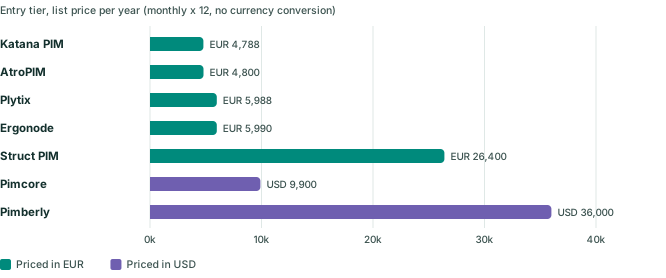
Akeneo, Bluestone, Sales Layer, Salsify and Quable do not publish a list price. Catsy, outside this profile set, is also quote only. Do not fill the gap with a competitor's estimate.
Cited in the file, not printed as codes: R13 S06, R13 S07, R13 S08, R13 S14, R13 S15, R13 S18, R13 S22
This page is longer than A4. The words are all here. The print page would need a cut.
Do not print Akeneo from USD 45,000 (a competitor estimate) or Bluestone AWS prices (not re-verified). Quote only: Akeneo, Bluestone, Sales Layer, Salsify, Quable.
6 Chart page
Guides say 4 to 12 weeks to a first channel for a smaller firm, and 6 to 18 months for a large rollout. Those are vendor claims.
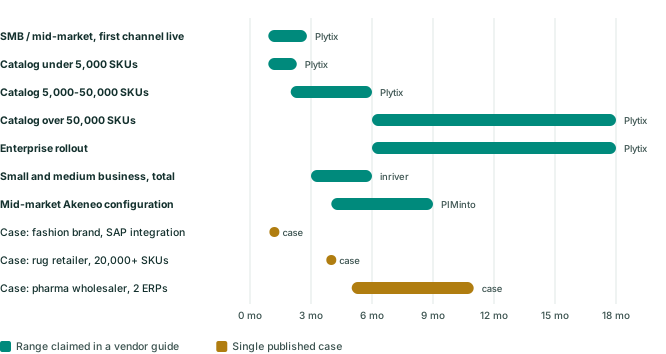
Plytix's guide says 4 to 12 weeks for a smaller first channel, and 6 to 18 months for an enterprise or a catalogue above 50,000 SKUs (Plytix 2026). inriver's guide says 3 to 6 months for a smaller firm and up to 12 months for an enterprise (inriver 2026). Neither guide cites a sample.
Three published cases give a duration, each as a vendor or partner claim. Marc O'Polo: 5 weeks to go live, with an SAP integration. Carpeto: 4 months, on more than 20,000 SKUs. Zur Rose Pharma: 5 months to a first go-live and 11 months for the whole project. Most case studies we opened state no duration and no cost.
Cited in the file, not printed as codes: R13 S36, R13 S37, R13 S38, R13 S39, R13 S40, R13 S41
This page is longer than A4. The words are all here. The print page would need a cut.
All durations are vendor or partner claims. Most case studies state no duration.
5 Text page
Licence, implementation and maintenance have vendor ratios. Internal staff time and data cleansing do not.
Payback of 12 to 24 months is PIMvendors guidance. It is not a study.
A full cost has eight parts: the licence or subscription, implementation, integrations, migration and cleansing, training, support and maintenance, running costs, and the time of your own staff. The last part has no public benchmark. It is the cost buyers leave out of the spreadsheet.
Vendors do publish ratios, and they are claims. Bluestone says 20–40% of the first-year budget goes to migration, onboarding, configuration and integration, and 10–15% to training and process redesign (Bluestone 2026). inriver says enterprise implementation costs at least one annual licence, and that on-premises maintenance is 15–25% of the licence a year (inriver 2026). A PIMvendors knowledge-base note uses that same 15–25% maintenance band. It is our note, not an independent audit.
Payback, in our guidance, takes 12 to 24 months. That replaces earlier ranges we have used. It is experience, not a measured sample. Vendor-commissioned studies claim faster payback. A Forrester Total Economic Impact study commissioned by Salsify reports 7 months (Forrester 2024, commissioned). Label it as commissioned if you cite it. Do not average it with our range.
For context only, and it is not about PIM: Flyvbjerg and Budzier, in 2011, found an average IT cost overrun of 27%, and about one project in six near a 200% overrun. The paper is old. No PIM-specific failure rate exists. Do not invent one, and do not reuse any "70% of projects fail" line. Those lines did not survive the check of the 2025 edition.
The cost calculator on pimreport.com is not used in this chapter. Its unit of work is still undefined, and its sample profiles sat above the public prices. Until that unit is explained, the calculator stays off the page.
Cited in the file, not printed as codes: R13 S28, R13 S30, R13 S04, R13 S48, R13 S51
This page is longer than A4. The words are all here. The print page would need a cut.
Calculator scenarios are not printed. The unit of work is an open question (PLAN section 6). Flyvbjerg 2011 is general IT and stale, context only. No PIM failure rate.
3 Chapter opener
Platforms bought the data layer, private equity bought control, and small vendors joined forces.
This page is longer than A4. The words are all here. The print page would need a cut.
6 Chart page
The announcements almost always say the point is data that AI can use.
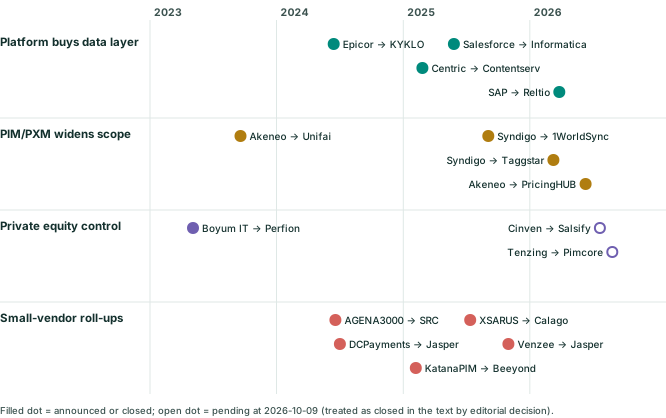
Four patterns cover the deals we could date.
Platforms bought the data layer. Salesforce announced Informatica on 27 May 2025 and closed on 18 November 2025, at about USD 8 billion of equity value. SAP announced Reltio on 27 March 2026 and closed on 7 May 2026. Centric, part of Dassault Systèmes, agreed to buy Contentserv for an enterprise value of EUR 220 million on 25 February 2025. Epicor bought KYKLO on 14 June 2024.
PIM vendors widened what they sell. Akeneo bought Unifai on 19 September 2023 and announced PricingHUB on 11 June 2026. Syndigo bought 1WorldSync on 3 September 2025 and Taggstar on 10 March 2026.
Private equity took control. Boyum IT, backed by Volpi, bought Perfion in 2023. Cinven announced control of Salsify on 22 July 2026. Tenzing announced control of Pimcore on 27 August 2026. This report treats those two 2026 deals as closed.
Smaller vendors were absorbed. AGENA3000 bought SRC. The working date is 15 May 2024. Katana PIM bought Beeyond on 6 February 2025. Venzee closed the purchase of Jasper on 31 December 2025. XSARUS bought Calago in July 2025.
The stated reason, across the platform announcements, is data ready for AI.
Cited in the file, not printed as codes: R07
This page is longer than A4. The words are all here. The print page would need a cut.
SRC date is 15 May 2024 per DECISIONS 5, not 19 June. Cinven–Salsify and Tenzing–Pimcore are treated as closed (DECISIONS 4) without a completion date. Chart data in outputs/R07 still needs that SRC date fix (PLAN phase 1).
5 Text page
The question after a deal is whether the PIM you would buy is still the product they intend to keep.
| Group | What changed | Examples |
|---|---|---|
| Platform-owned | An enterprise software company bought the data product | Informatica Product 360 (Salesforce, closed 18 November 2025). Reltio (SAP, closed 7 May 2026). Contentserv, now Centric PXM (Dassault Systèmes, February 2025). |
| Private equity control | A fund agreed to take control | Salsify (Cinven, 22 July 2026). Pimcore (Tenzing, 27 August 2026). Perfion (Boyum IT, 2023). We treat the two 2026 deals as closed. |
| Roll-ups | A smaller firm joined a group | SRC (AGENA3000, 15 May 2024). Beeyond (Katana PIM, 6 February 2025). Dynamicweb renamed Truvio on 21 January 2026, without an ownership change in the release. |
Our reading is that the risk is different in each group. Inside a platform, the PIM may become one module among many. Ask whether it still has its own roadmap. Inside a new fund, the risk is price and hold period. Ask what the renewal looks like. Inside a roll-up, the risk is that the product you saw in 2025 now shares a name, a support desk or a codebase with something else. Ask what stayed.
None of this is a reason to prefer one group. It is a reason to put two clauses in the contract: what happens if control changes again, and what the price may do at renewal.
Cited in the file, not printed as codes: R07
This page is longer than A4. The words are all here. The print page would need a cut.
Owner column is shortened from vendor-list.csv. Facts only. Groups are our reading of R07.
10 Vendor landscape
Left to right is the segment the vendor sells to. The bands are the steps in the value chain it names. Neither axis is a score.
The landscape figure is not drawn in this preview. The words under it are.
The position of a logo follows two rules only. The horizontal place is the segment: entry-level, mid-market, or enterprise, taken from the 2025 edition or from the profile where the vendor is new. The band is the value-chain step the vendor names: manufacturing, wholesale and distribution, or retail and brands. A vendor that names more than one step appears in more than one band.
The figure is not a ranking. Distance from the centre means nothing. Absence from a band means the vendor did not name that audience, not that it cannot serve it.
Cited in the file, not printed as codes: R17
This page is longer than A4. The words are all here. The print page would need a cut.
Positions come from vendor-list segment and R17 value chain. New vendors need the same directory method before the figure is final. Name in type under every logo. Tiles at least 70 px. Bluestone HQ is unresolved and does not affect this figure.
5 Text page
Two scored matrices are public. The rest are gated. This page records inclusion only, and only where a public page names the vendor.
Absence from an analyst list says nothing about quality.
ISG's Buyers Guide for PIM platforms in 2026 covers 21 providers in a free four-page summary (ISG 2026). Info-Tech's Data Quadrant for PIM, July 2026, covers 13 products and is free (Info-Tech 2026). Forrester's PIM landscape of the third quarter of 2026 lists 23 vendors. Of those names, only novomind is confirmed on a page we could read. The others are gated. IDC's 2025 MarketScape is gated. A full inclusion grid for all 40 vendors is not printed, because we will not fill a blank cell with a guess.
Vendors from the 2025 edition that a public 2026 summary we could read does name, as a group and not as a ranking: Akeneo, Bluestone PIM, censhare, Centric, inriver, novomind, Pimcore, Sales Layer, Stibo Systems, Syndigo and Viamedici. Perfion's owner, Boyum IT, appears on an emerging-provider list. That link is our inference. Among vendors added in this edition, Salsify and Plytix are named in those public ISG materials.
No score, no medal and no quadrant is printed. A vendor that is missing from this paragraph may be in a gated report, or in none. Both are possible. Neither is a finding about the product.
Cited in the file, not printed as codes: R14 S07, R14 S10, R03 S22, R03 S23, R03 S24
This page is longer than A4. The words are all here. The print page would need a cut.
No scores and no placements. The gated quadrant is not cited. Forrester landscape Q3 2026 names 23 vendors; only novomind is confirmed on a page we could read. The named-in-public list is R03's group, not a cell-by-cell matrix.
3 Chapter opener
Our home market: marketplaces with strict content rules, sector standards with real weight, and most of the vendors in this report.
This page is longer than A4. The words are all here. The print page would need a cut.
6 Chart page
Germany and Belgium grew. Dutch online spending fell 1% because services fell, while products grew 2%.
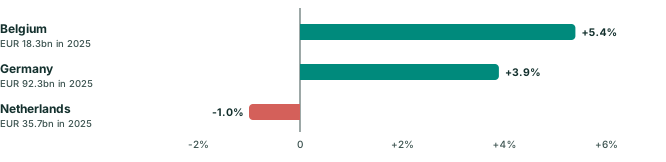
Germany's online sales of goods were EUR 92.3 billion in 2025, up 3.9%, excluding services and VAT. The HDE forecast for 2026 is EUR 96.3 billion (HDE 2026). The Netherlands recorded EUR 35.7 billion, down 1%, and that series includes services. Product sales in the Netherlands grew 2% (Thuiswinkel.org / GfK 2026). Belgium recorded EUR 18.3 billion, up 5.4% (Becom 2026). Compare the growth rates. Do not add the totals.
Marketplaces carried 56.7% of German online sales in 2025 (HDE 2026). HDE also reports that 35% of Germans use AI when researching a purchase (HDE 2026). A third-party compilation puts bol at about 13.5 million customers and 62,000 sellers. That pair of figures is low confidence and needs a primary source before it is repeated.
Cited in the file, not printed as codes: R15 S04, R15 S05, R15 S01, R15 S06, R15 S11
This page is longer than A4. The words are all here. The print page would need a cut.
bol customer and seller counts are a third-party compilation, low confidence, verify before print.
5 Text page
Amazon's content rules were not researched for this edition. They are not guessed.
| Marketplace | What the public rules require | Limit on what we read |
|---|---|---|
| bol | An EAN. A missing EAN is a declined upload. New products need a GPC code and the category's base attributes. Images from 500 to 6,000 pixels, white main image. | Rules are in the public API and partner pages. |
| Zalando | Attributes by category, material mapping, at least three consecutive clothing sizes, titles under 101 characters with no sustainability claim in the title, and sustainability standard attributes. | The EAN rule was not on the public pages. Pixel minimums were not found. |
| OTTO Market | An EAN on new products. Brand and category must match OTTO's reference data. | Image minimums in secondary extracts disagree, so no pixel figure is printed. The full attribute list is behind the partner schema. |
| Kaufland | Six mandatory fields: EAN, category, title, description, images, manufacturer. Category rules add legal data. Alt text has been required since June 2025. Main image on white, at least 1,024 pixels. | EAN-13 as the only accepted form was not on the primary page. |
Amazon was not in this research. Do not copy another marketplace's rules onto Amazon and call them current.
Cited in the file, not printed as codes: R15 S08, R15 S09, R15 S10, R15 S12, R15 S13, R15 S14, R15 S16
This page is longer than A4. The words are all here. The print page would need a cut.
Zalando EAN rule was NOT FOUND on public pages. OTTO image minimums conflict and are omitted. White background is included because this page is the rules page.
5 Text page
GS1, ETIM, 2BA, ECLASS and BMEcat are how wholesale and installation markets in this region move product data.
GS1 Nederland, GS1 Belgilux and GS1 Germany run the identifier and the data-pool services, and they publish support for digital product passports. The clearest enforced scheme we found is GS1 Germany's data-quality programme for food and near-food, which travels through GDSN. A record that fails it does not travel.
ETIM is the classification technical wholesalers use. It has 16 national organisations. The headquarters is in Margraten, in the Netherlands. ETIM 11.0 is final on 1 December 2026 (ETIM 2026). 2BA, for installation and construction, sits on ETIM. Calling 2BA mandatory in practice is our inference from how the sector buys. It is not a statute. Label it that way if you repeat it.
ECLASS 16.0 and BMEcat are the other two formats a German industrial buyer may require. BMEcat is the exchange file. ECLASS is the classification inside it. A PIM that cannot map to either will not pass a technical wholesale onboarding, whatever its commerce connectors look like.
Cited in the file, not printed as codes: R15 S23, R15 S26, R15 S30, R11 S30
This page is longer than A4. The words are all here. The print page would need a cut.
2BA 'mandatory in practice' is an inference. ETIM 11.0 date is 1 December 2026.
5 Text page
Seventeen of those 28 vendors are headquartered in the Benelux or in DACH. The twelve newer profiles are not in that count.
Of the 28 vendors in the 2025 edition, 17 are headquartered in the Benelux or in DACH: 10 in the Netherlands, 5 in Germany, 1 in Belgium and 1 in Austria (our count from the 2025 edition and the vendor sites, 2026). Bluestone is inside the Dutch ten because the 2025 edition placed it there. Its website suggests Norway. That conflict is unresolved, so do not treat the country as settled.
Others keep an office without moving the headquarters. Akeneo lists Düsseldorf and Amsterdam. Stibo Systems lists Hamburg, Utrecht and Geneva. inriver lists Munich and Amsterdam. Syndigo lists Cologne.
Partner pages for Pimcore, Akeneo, Stibo Systems, Bluestone and SyncForce show local firms. Those directories are the vendor's own list. They are not complete, and a logo is not a commitment of hours.
Three 2027 events are confirmed. E-Commerce Berlin Expo is on 17 and 18 February. Webwinkel Vakdagen is on 7 and 8 April in Utrecht. dmexco is on 22 and 23 September in Cologne. A 5 to 8 April date for Hannover Messe comes from trade press only. Confirm it on the organiser's site before you print it as fact.
Cited in the file, not printed as codes: R15 S57, R15 S48, R15 S49, R15 S50, R15 S51
This page is longer than A4. The words are all here. The print page would need a cut.
Bluestone counted as NL in the 17 because the 2025 edition said so. The website suggests Norway. Unresolved. Partner samples are not a complete directory.
3 Chapter opener
A neutral route from do we need one to a shortlist, and the questions that separate the vendors.
This page is longer than A4. The words are all here. The print page would need a cut.
5 Text page
No neutral decision tree existed in the public material we reviewed. This one is ours. It ends in a type of system.
Start with the pain. If channels disagree and the content drifts, you are looking at a PIM. If the same customer, supplier and product facts must survive across the company, look at MDM first. If the files and the rights are the chaos, look at a DAM and link a PIM to it.
Then ask who owns the work. One team, and a small IT group, can carry a suite that includes media and publishing. A DAM, an ERP or a commerce engine that is already in place points to a separate PIM with connectors.
Then the catalogue. Simple products, under about 5,000 SKUs, and a short attribute list, can live in a lighter system. Variants, configured products or engineered products mean you check who owns PLM and CPQ before you pick the PIM.
Then the channels. Marketplace-heavy sales need native syndication, and a feed if the PIM does not name one. Only 4 of the 28 vendors in the 2025 edition name feed management as native. AI channels need a feed you control and a written answer on MCP, from chapters 04 and 05.
Then the regulation that actually applies to your products. Batteries, textiles, food and energy labels need DPP, ETIM or GDSN support in writing, not as a slogan. Chapter 06 is the date list.
Then the money. A published tier and a quote are different kinds of number. Take a three-year view and include your own staff time. Chapter 08 is the method. Payback of 12 to 24 months is our guidance, not a result from this tree.
The end of every branch is a type: a content PIM, an MDM-first sequence, a DAM plus a PIM, a suite, a separate PIM, a feed tool beside the PIM. It is never a vendor.
Cited in the file, not printed as codes: R14, R12, R13
This page is longer than A4. The words are all here. The print page would need a cut.
R14 found only vendor quizzes, no neutral tree. Branches are our wording. End nodes never name a vendor.
12 Buyer checklist
Each answer is yes, no, or a document. A demo is not an answer.
Cited in the file, not printed as codes: R04, R07, R13
This page is longer than A4. The words are all here. The print page would need a cut.
Commercial questions follow R13 and R07. AI questions follow chapter 04. No analyst firm is named.
5 Text page
There is no independent PIM failure rate. The figures that exist are old, narrow, or ours.
Do not put a failure rate in a business case. No independent study measures how often a PIM project fails. Any round number of that kind in the 2025 edition was cut.
The nearest independent look is a 2021 study by ZHAW of more than 100 companies in DACH. It is stale. Respondents named insufficient staff at about 10%, lack of PIM expertise at about 9%, and then unclear responsibilities, a complex implementation and unwillingness to change processes at about 7–8% each (ZHAW 2021). Read it as a list of causes from that sample, not as a rate you can import.
Our own whitepaper names seven mistakes: no strategy, a process the software does not fit, the wrong stakeholders, data that is not ready, integration left too late, a scope that moves, and training that never happens. Those are our experience. They are not statistics. They line up with the ZHAW list on people, process and ownership, which is why we still use them.
A vendor will show you a feature gap. The stalls we can evidence are earlier. Nobody owns the record. The people who know the data are not on the project. The process stays the spreadsheet, with a new interface in front of it.
Cited in the file, not printed as codes: R13 S44, R13 S03
This page is longer than A4. The words are all here. The print page would need a cut.
ZHAW 2021 is stale. The seven mistakes are our whitepaper, experience not statistics. No 70% failure figure.
5 Text page
Five definitions you can audit. No target percentage, because no independent benchmark exists.
Completeness is the share of required attributes that are filled, for a channel you name. An attribute that a marketplace does not require is not part of that share.
Validity is whether a value is a legal value. A GTIN with a wrong check digit is invalid even when the field is full.
Consistency is whether the same fact matches across channels. The material on the shop and the material in the marketplace feed are one test.
Timeliness is how old the price and the availability are, against a refresh rule you set. Chapter 05 noted that the AI feed specifications do not set that interval for you.
Channel readiness is the share of SKUs that meet the completeness, validity and image rules of one channel. One vendor index uses "at least 85% publish-ready" as its own benchmark (inriver 2025). That is a vendor claim about its index. It is not a target for your programme. No independent benchmark of these five was found.
ISO 8000 is the standard family the 2025 edition pointed at for data quality. The parts we could identify are ISO 8000-1:2022 and ISO 8000-100:2016 (ISO 2022; ISO 2016). We do not summarise them. The text is paywalled, and earlier sentences about lineage and profiling could not be checked, so they are gone.
Set the five definitions with your team before the vendor's project plan is signed. A measure invented after go-live will describe the project you had, not the one you needed.
Cited in the file, not printed as codes: R09 S4, R14 S53, R05 S46
This page is longer than A4. The words are all here. The print page would need a cut.
ISO 8000-61 lineage and profiling sentences are cut. Only ISO 8000-1:2022 and ISO 8000-100:2016 are cited, and only as the parts R05 identified, not as a summary of their text.
3 Chapter opener
40 PIM vendors, alphabetical, facts only.
This page is longer than A4. The words are all here. The print page would need a cut.
5 Text page
Inclusion is a rule we publish. It is not an endorsement, and it is not a ranking.
A vendor is in this chapter for one of three reasons. It was in the 2025 edition, which accounts for 28 profiles. Or our coverage scan scored it 6 or higher out of 8, which added crossbase, Struct, Goaland and Quable. Or it was added because European buyers were already meeting it in a 2026 evaluation: Salsify, Plytix, apollon, Pimberly, Agility PIM, Informatica Product 360, Equadis and Base.com. Base.com is still an open decision, because its centre of gravity is syndication. We do not print placements from gated research. Being in this list is not a score.
Names have changed since the 2025 edition. Contentserv is now Centric PXM. Dynamicweb is now Truvio. Informatica Product 360 belongs to Salesforce. Perfion belongs to Boyum IT. SRC belongs to AGENA3000, dated 15 May 2024.
A profile page has the same parts for every vendor. Four tiles: founded, headquarters, deployment, and how many of twelve AI capabilities are documented as generally available. Three columns: what the product is, where it fits, and which modules the vendor names. Dots for AI status. Up to four customer logos, each a vendor claim. A "Good to know" box with one change, one fact and one question to ask. A second page only if a customer case passed the rules. Results on that page are vendor claims.
Order is alphabetical. No vendor reviewed its own profile before this draft. Where two sources disagreed, the page keeps the higher one and the conflict sits in the production notes.
Cited in the file, not printed as codes: R03, R02, R07
This page is longer than A4. The words are all here. The print page would need a cut.
No quadrant placements. Base.com remains an open editorial decision. Vendors were not invited to correct facts before this draft. The unpaid-inclusion sentence is still open and is not printed.
9 Vendor profile

Akeneo Product Cloud manages and publishes product information for manufacturers.
Founded in 2013, Akeneo Product Cloud is the product Akeneo sells for managing and publishing product information. The company is based in France. It names manufacturers, wholesalers, retailers and brands. The stated segment is Midmarket / Enterprise. Native modules confirmed here: PIM, DAM, syndication. Acquired PricingHUB (announced 2026-06-11); Stripe agentic-commerce partnership (2026-02-18); Summer Release 2026 'Agentic Ziggy' (2026-07-08); Product Cloud adds SDM; PX Insights; Digital Showroom; RCS Nantes 790
Product: Akeneo Product Cloud. Licence: Open Source. Audience named: manufacturing, wholesale distribution, retail brands.
Acquired PricingHUB (announced 2026-06-11); Stripe agentic-commerce partnership (2026-02-18); Summer Release 2026 'Agentic Ziggy' (2026-07-08); Product Cloud adds SDM; PX Insights; Digital Showroom; RCS Nantes 790.
No public list price was found. Treat any number from a third party as unusable.
Ask the vendor: which beta AI features have a written date to become generally available?




This page is longer than A4. The words are all here. The print page would need a cut.
Analyst reprint leads were not copied. Regional presence: Offices Dusseldorf DE, Amsterdam NL; partners valantic, kernpunkt, Induxx Logo: icon
11 Customer case (conditional)
Sporting goods · France
Case status in the file: rewrite. Source date: 2020.
Direct-to-consumer and wholesale product content.
Babolat wanted one product record for its channels, with R&D, product and sales on the same model.
Akeneo PIM. The vendor's page still states an error-rate figure that cannot be a reduction, so the figure is omitted.
No result figures are printed on this page.
This page is longer than A4. The words are all here. The print page would need a cut.
Rewrite. The 400% error reduction is impossible as a reduction. Figure omitted. Source is stale (2020). Only if case.status = use or rewrite; otherwise remove this row. 2025 case: Babolat
9 Vendor profile

AtroPIM manages and publishes product information for manufacturers.
Founded in 2017 in report; company AtroCore GmbH 'founded 2020' per vendor [S45]: product vs company year, needs vendor confirmation, AtroPIM is the product AtroPIM sells for managing and publishing product information. The company is based in Germany. It names manufacturers, wholesalers, retailers and brands. The stated segment is Entry-level / Midmarket. Native modules confirmed here: PIM, DAM, syndication, feed management. Company address on legal notice differs from report; AtroPIM.
Product: AtroPIM. Licence: Open Source and Proprietary Software. Audience named: manufacturing, wholesale distribution, retail brands.
Company address on legal notice differs from report; AtroPIM now offers Gemini/ChatGPT/Claude integrations (vendor); blog active to 2026-10-05
Publishes a list price: 400 EUR month.
Ask the vendor: which modules on this page are in the product you would licence?




This page is longer than A4. The words are all here. The print page would need a cut.
Analyst reprint leads were not copied. Regional presence: HQ Regensburg DE Logo: icon
9 Vendor profile

BetterCommerce manages and publishes product information for retailers and brands.
Founded in 2016 in report; OmniCX Digital incorporated 3 Nov 2015 (as Saambukapu Ltd, renamed 17 Nov 2016) [S48]; third-party summary says 2015: needs vendor confirmation, BetterCommerce is the product BetterCommerce sells for managing and publishing product information. The company is based in United Kingdom. It names retailers and brands. The stated segment is Midmarket / Enterprise. Native modules confirmed here: PIM, DAM, DXP/CMS, commerce. Positioning: B2B commerce platform with.
Product: BetterCommerce. Licence: n/a (the licence row reads 'API-first and Cloud Native Software'). Audience named: retail brands.
Positioning: B2B commerce platform with PIM as one of seven modules; similarly named BETTERCOMMERCE DIGITAL LTD (15519274) dissolved 7 Apr 2026; reason unknown; OmniCX accounts.
Licence on file: n/a (the licence row reads 'API-first and Cloud Native Software').
Ask the vendor: which modules on this page are in the product you would licence?



This page is longer than A4. The words are all here. The print page would need a cut.
Now positions as a B2B commerce platform with PIM as one module (R02-A). Analyst reprint leads were not copied. Regional presence: NOT FOUND (not checked) Logo: icon; Now positions as a B2B commerce platform with PIM as one module (R02-A).
11 Customer case (conditional)
Luxury women's fashion (UK) · NOT FOUND
Case status in the file: use. Source date: 2025 edition.
Comprehensive omnichannel solution unifying systems, eliminating silos and modernizing operations
Previous Magento-based platform with limited functionality, fragmented tech stack and lack of modern features for engagement and management
Comprehensive omnichannel solution unifying systems, eliminating silos and modernizing operations
This page is longer than A4. The words are all here. The print page would need a cut.
Named PIM case from the 2025 edition. Results are vendor claims. Reconfirm the page on the vendor site before print. Only if case.status = use or rewrite; otherwise remove this row. 2025 case: Forever Unique
9 Vendor profile

Bluestone PIM manages and publishes product information for manufacturers.
Founded in 2016 (vendor [S38]); legal entity registered 2000, renamed 2018 [S36], Bluestone PIM is the product Bluestone PIM sells for managing and publishing product information. The company is based in a headquarters this pass could not confirm. It names manufacturers, wholesalers, retailers and brands. The stated segment is Midmarket / Enterprise. Native modules confirmed here: PIM, DAM. AI Agent launched 2025-10-21; Starboard case updated 2025-04-10; Digital Product Passport release.
Product: Bluestone PIM. Licence: Proprietary Software. Audience named: manufacturing, wholesale distribution, retail brands.
AI Agent launched 2025-10-21; Starboard case updated 2025-04-10; Digital Product Passport release 2026-03-02; 'Agent Ready 2026' MACH badge (vendor)
No public list price was found. Treat any number from a third party as unusable.
Ask the vendor: which modules and AI features sit in the base licence, and which cost extra?




This page is longer than A4. The words are all here. The print page would need a cut.
HQ country NL vs Norway unresolved (R15). Analyst reprint leads were not copied. Regional presence: Office Utrecht NL; partners NL, BE, DACH Logo: wordmark; HQ country NL vs Norway unresolved (R15).
11 Customer case (conditional)
Water sports equipment (SUPs, windsurfing boards) · NOT FOUND
Case status in the file: use. Source date: 2025 edition.
Bluestone PIM
Starboard's products are very seasonal and require constant updates; needed flexibility and ease of collaboration between teams and scalability to grow globally
Bluestone PIM
This page is longer than A4. The words are all here. The print page would need a cut.
Named PIM case from the 2025 edition. Results are vendor claims. Reconfirm the page on the vendor site before print. Only if case.status = use or rewrite; otherwise remove this row. 2025 case: Starboard
9 Vendor profile

censhare Digital Experience Platform manages and publishes product information for manufacturers.
Founded in 2001 in report; Handelsregister data shows GmbH founded 2002-01-04 [S57]; Noerr 2017 says AG founded 2001 [S53]: legal-form change, needs vendor confirmation, censhare Digital Experience Platform is the product censhare sells for managing and publishing product information. The company is based in Germany. It names manufacturers, retailers and brands. The stated segment is Midmarket / Enterprise. Native modules confirmed here: PIM, DAM, syndication, DXP/CMS. Positioned inside Entirely ecosystem.
Product: censhare Digital Experience Platform. Licence: Proprietary Software. Audience named: manufacturing, retail brands.
Positioned inside Entirely ecosystem (2025-2026); GmbH HRB 260410 Munchen; MDs Stefan Heide and Alexander Roethinger; censhare CEO Tobias Ackermann moved to Entirely CEO (date NOT.
Licence on file: Proprietary Software.
Ask the vendor: which modules on this page are in the product you would licence?




This page is longer than A4. The words are all here. The print page would need a cut.
Analyst reprint leads were not copied. Regional presence: HQ Munich DE Logo: wordmark
11 Customer case (conditional)
Cooperative purchasing organisation, Swiss car and motor vehicle industry · NOT FOUND
Case status in the file: use. Source date: 2025 edition.
Holistic platform addressing agile data routing, content management and DAM, integrated with PIM; requirements aligned via stakeholder workshops
~7,000 B2B customers, 5+ online shops and 500,000+ product data assets; needed to ensure quality, relevance and cost-effective operations in a fast-changing digital market
Holistic platform addressing agile data routing, content management and DAM, integrated with PIM; requirements aligned via stakeholder workshops
This page is longer than A4. The words are all here. The print page would need a cut.
Named PIM case from the 2025 edition. Results are vendor claims. Reconfirm the page on the vendor site before print. Only if case.status = use or rewrite; otherwise remove this row. 2025 case: ESA
9 Vendor profile

Centric PXM manages and publishes product information for manufacturers.
Founded in Contentserv founded in 2000 per Dassault and McDermott [S18,S19]; report printed 1999 (needs correction or vendor explanation), Centric PXM is the product Centric PXM (Centric Software) sells for managing and publishing product information. The company is based in United States. It names manufacturers, retailers and brands. The stated segment is Midmarket / Enterprise. Native modules confirmed here: PIM, DAM, syndication, feed management. Acquisition announced 2025-02-25; rebranded Centric PXM.
Product: Centric PXM. Licence: Proprietary Software. Audience named: manufacturing, retail brands.
Acquisition announced 2025-02-25; rebranded Centric PXM; shown at K5 Berlin June 2025; contentserv.com and its case URLs redirect to centricsoftware.com
Licence on file: Proprietary Software.
Ask the vendor: which modules on this page are in the product you would licence?




This page is longer than A4. The words are all here. The print page would need a cut.
Directory logo is the old Contentserv mark: replace with the Centric Software / Centric PXM logo from centricsoftware.com (permission). Analyst reprint leads were not copied. Regional presence: NOT FOUND (not checked); Contentserv origin Germany per R02 batch note Logo: icon; Directory logo is the old Contentserv mark: replace with the Centric Software / Centric PXM logo from centricsoftware.com (permission).
11 Customer case (conditional)
Manufacturing of environmental simulation chambers and industrial ovens (Germany) · NOT FOUND
Case status in the file: use. Source date: 2025 edition.
Centric PXM for product information and DAM, Translation Manager, Workflow Management
Needed to centralize, manage and automate product information and digital assets, with translation and workflow management
Centric PXM for product information and DAM, Translation Manager, Workflow Management
This page is longer than A4. The words are all here. The print page would need a cut.
Named PIM case from the 2025 edition. Results are vendor claims. Reconfirm the page on the vendor site before print. Only if case.status = use or rewrite; otherwise remove this row. 2025 case: BINDER
9 Vendor profile

ConnectingTheDots PIM manages and publishes product information for manufacturers.
Founded in 2008 in report; ID interactive renamed ConnectingTheDots Oct 2017 and was 'ten years old' (implies ~2007, inference) [S62]: needs vendor confirmation, ConnectingTheDots PIM is the product ConnectingTheDots sells for managing and publishing product information. The company is based in Netherlands. It names manufacturers, wholesalers, retailers and brands. The stated segment is Midmarket / Enterprise. Native modules confirmed here: PIM, syndication, feed management. Qmica partnership announced 2026-01-27; Emerce 100.
Product: ConnectingTheDots PIM. Licence: Proprietary Software. Audience named: manufacturing, wholesale distribution, retail brands.
Qmica partnership announced 2026-01-27; Emerce 100 shared first place 2025-04-22; case list now 11 named cases
Licence on file: Proprietary Software.
Ask the vendor: which modules on this page are in the product you would licence?




This page is longer than A4. The words are all here. The print page would need a cut.
Analyst reprint leads were not copied. Regional presence: HQ Zwolle NL Logo: icon
9 Vendor profile

Truvio (formerly Dynamicweb) manages and publishes product information for manufacturers.
Founded in 1999 [S4], Truvio (formerly Dynamicweb) is the product Truvio (formerly Dynamicweb) sells for managing and publishing product information. The company is based in Denmark. It names manufacturers, wholesalers, retailers and brands. The stated segment is Midmarket / Enterprise. Native modules confirmed here: PIM, DAM, DXP/CMS, commerce. Brand being replaced by Truvio (launch 21 Jan 2026); product marketed as Truvio Commerce / Truvio PIM; dynamicweb.com still live
Product: Truvio (formerly Dynamicweb). Licence: NOT FOUND on current site; needs vendor confirmation. Audience named: manufacturing, wholesale distribution, retail brands.
Brand being replaced by Truvio (launch 21 Jan 2026); product marketed as Truvio Commerce / Truvio PIM; dynamicweb.com still live .
Licence on file: NOT FOUND on current site; needs vendor confirmation.
Ask the vendor: which modules on this page are in the product you would licence?




This page is longer than A4. The words are all here. The print page would need a cut.
Renamed Truvio on 2026-01-21 (R02-B). Directory logo is the old Dynamicweb mark: replace with the Truvio logo. Analyst reprint leads were not copied. Regional presence: NOT FOUND (not checked) Logo: wordmark; Renamed Truvio on 2026-01-21 (R02-B). Directory logo is the old Dynamicweb mark: replace with the Truvio logo.
9 Vendor profile

Ergonode manages and publishes product information for retailers and brands.
Founded in 2018 (print); legal entity registered 2021 [S73]; needs vendor confirmation, Ergonode is the product Ergonode sells for managing and publishing product information. The company is based in Poland. It names retailers and brands. The stated segment is Entry-level / Midmarket. Native modules confirmed here: PIM, syndication. Deployment in print ("On Premise") conflicts with vendor case page and site (SaaS/cloud); free tier and tiered pricing now published; AI Photo.
Product: Ergonode. Licence: Open Source (print). Free and paid plans, Enterprise on request [S13]; GitHub repos OSL-3.0 but dormant since Feb 2023 [S16]; needs vendor confirmation. Audience named: retail brands.
Deployment in print ("On Premise") conflicts with vendor case page and site (SaaS/cloud); free tier and tiered pricing now published; AI Photo Studio launched Jul.
Publishes a list price: 5990 EUR year.
Ask the vendor: which modules on this page are in the product you would licence?




This page is longer than A4. The words are all here. The print page would need a cut.
Analyst reprint leads were not copied. Regional presence: NOT FOUND (not checked) Logo: icon
11 Customer case (conditional)
Premium violet glass packaging for beauty, health and food (80+ countries) · NOT FOUND
Case status in the file: use. Source date: 2025 edition.
Ergonode PIM: cloud-based, multilingual solution with workflow and user management
Decentralized product data, low quality and siloed processes; needed to centralize information, improve multilingual content and enhance team collaboration
Ergonode PIM: cloud-based, multilingual solution with workflow and user management
This page is longer than A4. The words are all here. The print page would need a cut.
Named PIM case from the 2025 edition. Results are vendor claims. Reconfirm the page on the vendor site before print. Only if case.status = use or rewrite; otherwise remove this row. 2025 case: MIRON Violetglass
9 Vendor profile

Gepard manages and publishes product information for wholesalers.
Founded in 2005 = development company start (Bintime); Gepard platform from 2015, SaaS multi-tenant 2021 [S21], Gepard is the product Gepard sells for managing and publishing product information. The company is based in Netherlands. It names wholesalers, retailers and brands. The stated segment is Entry-level / Midmarket. Native modules confirmed here: PIM, syndication. Repositioned "AI-first
Product: Gepard. Licence: Proprietary (print); freemium agreement on site [S19]; needs vendor confirmation. Audience named: wholesale distribution, retail brands.
Repositioned "AI-first ...
Licence on file: Proprietary (print); freemium agreement on site [S19]; needs vendor confirmation.
Ask the vendor: which modules on this page are in the product you would licence?




This page is longer than A4. The words are all here. The print page would need a cut.
Analyst reprint leads were not copied. Regional presence: Office Nieuwegein NL Logo: wordmark
11 Customer case (conditional)
Lighting manufacturer (global) · NOT FOUND
Case status in the file: use. Source date: 2025 edition.
Gepard PIM integrating ERP system and EPREL; real-time synchronization, standardized product formats, regulatory compliance, automated processes
Enhance time-to-market and ensure accurate product information delivery to the EPREL database
Gepard PIM integrating ERP system and EPREL; real-time synchronization, standardized product formats, regulatory compliance, automated processes
This page is longer than A4. The words are all here. The print page would need a cut.
Named PIM case from the 2025 edition. Results are vendor claims. Reconfirm the page on the vendor site before print. Only if case.status = use or rewrite; otherwise remove this row. 2025 case: Opple Lighting
9 Vendor profile

Inriver PIM manages and publishes product information for manufacturers.
Founded in 2007 [S26], Inriver PIM is the product inriver sells for managing and publishing product information. The company is based in Sweden. It names manufacturers, wholesalers, retailers and brands. The stated segment is Midmarket / Enterprise. Native modules confirmed here: PIM, syndication. Main phone differs from print; agentic AI release Mar 2026; Microsoft Certified Software May 2026 and SAP S/4HANA connector certified May 2026; Summer 2026 release
Product: Inriver PIM. Licence: Proprietary (SaaS). Audience named: manufacturing, wholesale distribution, retail brands.
Main phone differs from print; agentic AI release Mar 2026; Microsoft Certified Software May 2026 and SAP S/4HANA connector certified May 2026; Summer 2026 release.
Licence on file: Proprietary (SaaS).
Ask the vendor: does the MCP server use the same field permissions as a person?




This page is longer than A4. The words are all here. The print page would need a cut.
Analyst reprint leads were not copied. Regional presence: Offices Munich DE, Amsterdam NL Logo: wordmark
11 Customer case (conditional)
Equestrian equipment, apparel and accessories (Europe) · NOT FOUND
Case status in the file: use. Source date: 2025 edition.
Inriver PIM platform covering SKU creation and enrichment to publication
Modernize operations, replacing outdated systems; centralize all product information (19 web stores in 13 languages, 14 retail stores in six countries, 280,000+ SKUs)
Inriver PIM platform covering SKU creation and enrichment to publication
This page is longer than A4. The words are all here. The print page would need a cut.
Named PIM case from the 2025 edition. Results are vendor claims. Reconfirm the page on the vendor site before print. Only if case.status = use or rewrite; otherwise remove this row. 2025 case: Horze
9 Vendor profile

KatanaPIM manages and publishes product information for manufacturers.
Founded in 2017 (product) [S38]; company B.V. incorporated 2003 [S76], KatanaPIM is the product Katana PIM sells for managing and publishing product information. The company is based in Netherlands. It names manufacturers, wholesalers, retailers and brands. The stated segment is Entry-level / Midmarket. Native modules confirmed here: PIM, syndication. No change in contact data; release train 2.12 (Nov 2025) to 2.21 (Apr 2026); case pages OOSC and Polewolf last modified.
Product: KatanaPIM. Licence: Proprietary (print); monthly/yearly subscription plans [S43]. Audience named: manufacturing, wholesale distribution, retail brands.
No change in contact data; release train 2.12 (Nov 2025) to 2.21 (Apr 2026); case pages OOSC and Polewolf last modified 25 Nov 2025; Polewolf.
Publishes a list price: 399 EUR month.
Ask the vendor: which modules on this page are in the product you would licence?




This page is longer than A4. The words are all here. The print page would need a cut.
Analyst reprint leads were not copied. Regional presence: HQ Leiden NL Logo: icon
11 Customer case (conditional)
OOSC: sportswear (UK); Polewolf: lifestyle and home decor (Netherlands) · NOT FOUND
Case status in the file: use. Source date: 2025 edition.
OOSC: KatanaPIM as central platform for product data, translations, images and specifications; ChannelEngine integration for marketplace sync. || Polewolf: scalable PIM with fast onboarding and full catalog migration, training and support, Shopify and marketplace integration, validation rules and workflows
OOSC: managing expanding product content across multiple online marketplaces; manual handling resulted in errors and inefficiencies. || Polewolf: fragmented product information in spreadsheets led to inconsistent descriptions and slow time-to-market
OOSC: KatanaPIM as central platform for product data, translations, images and specifications; ChannelEngine integration for marketplace sync. || Polewolf: scalable PIM with fast onboarding and full catalog migration, training and support, Shopify and marketplace integration, validation rules and workflows
This page is longer than A4. The words are all here. The print page would need a cut.
Named PIM case from the 2025 edition. Results are vendor claims. Reconfirm the page on the vendor site before print. Only if case.status = use or rewrite; otherwise remove this row. 2025 case: OOSC (p68); Polewolf (p69)
9 Vendor profile

mediacockpit manages and publishes product information for the buyers it names.
Founded in 1996 per company blog [S79]; register entity from 2005 [S67]; needs vendor confirmation, mediacockpit is the product mediacockpit sells for managing and publishing product information. The company is based in Germany. It names an audience this pass could not confirm. The stated segment is Midmarket / Enterprise. Native modules confirmed here: PIM, DAM, syndication. Release 25.3 with expanded AI functions; Alanko AutomotivePIM story published Apr 2025; Linde and.
Product: mediacockpit. Licence: Proprietary (print). Audience named: NOT FOUND.
Release 25.3 with expanded AI functions; Alanko AutomotivePIM story published Apr 2025; Linde and LG logos from print not found on homepage; IHI Turbo page.
Licence on file: Proprietary (print).
Ask the vendor: which modules on this page are in the product you would licence?




This page is longer than A4. The words are all here. The print page would need a cut.
Logo is white on black: place on its own dark tile or get a positive version. Analyst reprint leads were not copied. Regional presence: HQ Stuttgart DE Logo: wordmark; Logo is white on black: place on its own dark tile or get a positive version.
11 Customer case (conditional)
Turbocharger design, manufacturing and distribution · NOT FOUND
Case status in the file: use. Source date: 2025 edition.
Bertsch Innovation's AutomotivePIM as central product information system; automated import, maintenance, enrichment and output; automatic link transfer between turbocharger and engine to vehicles, restrictions on vehicles
Maintenance and management of all product data, media content and relationships between vehicles and parts
Bertsch Innovation's AutomotivePIM as central product information system; automated import, maintenance, enrichment and output; automatic link transfer between turbocharger and engine to vehicles, restrictions on vehicles
This page is longer than A4. The words are all here. The print page would need a cut.
Named PIM case from the 2025 edition. Results are vendor claims. Reconfirm the page on the vendor site before print. Only if case.status = use or rewrite; otherwise remove this row. 2025 case: IHI Turbo
9 Vendor profile

novomind iPIM manages and publishes product information for manufacturers.
Founded in 2000 [S69,S70], novomind iPIM is the product novomind iPIM sells for managing and publishing product information. The company is based in Germany. It names manufacturers, wholesalers, retailers and brands. The stated segment is Midmarket / Enterprise. Native modules confirmed here: PIM, syndication, commerce. Named in Forrester PIM Systems Landscape Q3 2026 (6 Aug 2026); new customers announced: LG Electronics Deutschland (11 Aug 2026); EFB-Elektronik (17 Sep 2026); AI
Product: novomind iPIM. Licence: Proprietary (print). Audience named: manufacturing, wholesale distribution, retail brands.
Named in Forrester PIM Systems Landscape Q3 2026 (6 Aug 2026); new customers announced: LG Electronics Deutschland (11 Aug 2026); EFB-Elektronik (17 Sep 2026); AI.
Licence on file: Proprietary (print).
Ask the vendor: which modules on this page are in the product you would licence?




This page is longer than A4. The words are all here. The print page would need a cut.
Analyst reprint leads were not copied. Regional presence: HQ Hamburg DE Logo: icon
11 Customer case (conditional)
Federation of timber dealers (Germany, Austria, Norway, Benelux, Czechia; 450+ outlets) · NOT FOUND
Case status in the file: use. Source date: 2025 edition.
novomind iPIM with hundreds of automated clean-up and validation rules and a double-checking system
Handling 1.3 million article data sets from 250+ suppliers across 1,000+ catalogs; needed a streamlined onboarding process
novomind iPIM with hundreds of automated clean-up and validation rules and a double-checking system
This page is longer than A4. The words are all here. The print page would need a cut.
Named PIM case from the 2025 edition. Results are vendor claims. Reconfirm the page on the vendor site before print. Only if case.status = use or rewrite; otherwise remove this row. 2025 case: HolzLand
9 Vendor profile

OmniStock manages and publishes product information for wholesalers.
Founded in 1998, OmniStock is the product OmniStock sells for managing and publishing product information. The company is based in Netherlands. It names wholesalers, retailers and brands. The stated segment is Midmarket. Native modules confirmed here: PIM. Site presents OmniStock primarily as omnichannel retail logistics (OMS + PIM + smart stock); PIM is one of three solutions
Product: OmniStock. Licence: Proprietary Software. Audience named: wholesale distribution, retail brands.
Site presents OmniStock primarily as omnichannel retail logistics (OMS + PIM + smart stock); PIM is one of three solutions .
Licence on file: Proprietary Software.
Ask the vendor: which modules on this page are in the product you would licence?




This page is longer than A4. The words are all here. The print page would need a cut.
Soft removal flag: OMS-led product (R03, R12). Editorial decision. Analyst reprint leads were not copied. Regional presence: HQ Nijmegen NL Logo: wordmark; Soft removal flag: OMS-led product (R03, R12). Editorial decision.
9 Vendor profile

Perfion manages and publishes product information for manufacturers.
Founded in 1997, Perfion is the product Perfion sells for managing and publishing product information. The company is based in Denmark. It names manufacturers, wholesalers, retailers and brands. The stated segment is Midmarket / Enterprise. Native modules confirmed here: PIM, DAM, syndication. Website moved to perfion.boyum-solutions.com (2023-05-05)
Product: Perfion. Licence: Proprietary Software. Audience named: manufacturing, wholesale distribution, retail brands.
Website moved to perfion.boyum-solutions.com (2023-05-05).
Licence on file: Proprietary Software.
Ask the vendor: which modules on this page are in the product you would licence?




This page is longer than A4. The words are all here. The print page would need a cut.
Analyst reprint leads were not copied. Regional presence: NOT FOUND (not checked) Logo: wordmark
11 Customer case (conditional)
Furnishing solutions provider, Denmark (since 1914) · NOT FOUND
Case status in the file: use. Source date: 2025 edition.
Perfion PIM as central product data repository; Print Publishing module; ERP (Lawson M3) and CMS (Umbraco) integration enabling an online product configurator
Data fragmentation and inefficiencies in product data handling
Perfion PIM as central product data repository; Print Publishing module; ERP (Lawson M3) and CMS (Umbraco) integration enabling an online product configurator
This page is longer than A4. The words are all here. The print page would need a cut.
Named PIM case from the 2025 edition. Results are vendor claims. Reconfirm the page on the vendor site before print. Only if case.status = use or rewrite; otherwise remove this row. 2025 case: B8
9 Vendor profile

Pimalion manages and publishes product information for manufacturers.
Founded in 2015, Pimalion is the product Pimalion sells for managing and publishing product information. The company is based in Belgium. It names manufacturers, wholesalers, retailers and brands. The stated segment is Midmarket / Enterprise. Native modules confirmed here: PIM, DAM, MDM, syndication. Street address differs between report and current contact page (2015-07-02)
Product: Pimalion. Licence: Proprietary Software. Audience named: manufacturing, wholesale distribution, retail brands.
Street address differs between report and current contact page (2015-07-02).
Licence on file: Proprietary Software.
Ask the vendor: which modules on this page are in the product you would licence?




This page is longer than A4. The words are all here. The print page would need a cut.
Analyst reprint leads were not copied. Regional presence: HQ La Hulpe BE Logo: icon
11 Customer case (conditional)
Automotive distribution (Volkswagen Group brands in Belgium), spare parts, used cars, financing, leasing · NOT FOUND
Case status in the file: use. Source date: 2025 edition.
Pimalion: bulk imports, Excel-based batch operations, API-driven distribution to eCommerce, POS, Google Shopping and internal tools
Optimize product data management: automate tasks, centralize content, support faster decision-making
Pimalion: bulk imports, Excel-based batch operations, API-driven distribution to eCommerce, POS, Google Shopping and internal tools
This page is longer than A4. The words are all here. The print page would need a cut.
Named PIM case from the 2025 edition. Results are vendor claims. Reconfirm the page on the vendor site before print. Only if case.status = use or rewrite; otherwise remove this row. 2025 case: D'Ieteren
9 Vendor profile

Pimcore manages and publishes product information for manufacturers.
Founded in 2009, Pimcore is the product Pimcore sells for managing and publishing product information. The company is based in Austria. It names manufacturers, retailers and brands. The stated segment is Midmarket / Enterprise. Native modules confirmed here: PIM, DAM, MDM, syndication. Ownership: Tenzing deal (2026-09-02)
Product: Pimcore. Licence: Pimcore Open Core License (POCL), Community Edition free; was printed as "Open Source Software" [S11]. Audience named: manufacturing, retail brands.
Ownership: Tenzing deal (2026-09-02).
Publishes a list price: 9900 USD year.
Ask the vendor: which beta AI features have a written date to become generally available?




This page is longer than A4. The words are all here. The print page would need a cut.
Analyst reprint leads were not copied. Regional presence: HQ Salzburg AT; partner network mostly DACH plus Youwe NL, Studio Emma BE Logo: wordmark
9 Vendor profile

ProductFlow manages and publishes product information for wholesalers.
Founded in 2019, ProductFlow is the product ProductFlow sells for managing and publishing product information. The company is based in Netherlands. It names wholesalers, retailers and brands. The stated segment is Entry-level / Midmarket. Native modules confirmed here: PIM, syndication. Phone differs from report (+31 85 3012 283)
Product: ProductFlow. Licence: Proprietary Software. Audience named: wholesale distribution, retail brands.
Phone differs from report (+31 85 3012 283) .
Licence on file: Proprietary Software.
Ask the vendor: which modules on this page are in the product you would licence?




This page is longer than A4. The words are all here. The print page would need a cut.
Analyst reprint leads were not copied. Regional presence: HQ Houten NL Logo: icon
9 Vendor profile

Sales Layer manages and publishes product information for manufacturers.
Founded in 2013, Sales Layer is the product Sales Layer sells for managing and publishing product information. The company is based in Spain. It names manufacturers, wholesalers, retailers and brands. The stated segment is Midmarket. Native modules confirmed here: PIM, DAM, syndication. Street address now available (report: city only) (2025-12-11)
Product: Sales Layer. Licence: Proprietary Software. Audience named: manufacturing, wholesale distribution, retail brands.
Street address now available (report: city only) (2025-12-11).
No public list price was found. Treat any number from a third party as unusable.
Ask the vendor: which modules and AI features sit in the base licence, and which cost extra?




This page is longer than A4. The words are all here. The print page would need a cut.
Analyst reprint leads were not copied. Regional presence: NOT FOUND (contact page fetch 404) Logo: icon
11 Customer case (conditional)
Fashion · Spain
Case status in the file: rewrite. Source date: NOT FOUND.
Online sales.
The result is a customer quotation on the vendor's homepage, not an independent measurement.
Sales Layer. Attribute the words to María Selma, eCommerce manager at Ysabel Mora, via the vendor page.
This page is longer than A4. The words are all here. The print page would need a cut.
Rewrite. Use the exact homepage quotation. Do not write that sales exceeded target by 353%. Only if case.status = use or rewrite; otherwise remove this row. 2025 case: Ysabel Mora
9 Vendor profile

Signifikant manages and publishes product information for manufacturers.
Founded in 2004, Signifikant is the product Signifikant sells for managing and publishing product information. The company is based in Sweden. It names manufacturers. The stated segment is Midmarket / Enterprise. Native modules confirmed here: PIM, syndication, commerce. Address; phone; email unchanged (2004-03-12). Figures on this page are sourced in the profile record and are not a ranking.
Product: Signifikant. Licence: Proprietary Software. Audience named: manufacturing.
Address; phone; email unchanged (2004-03-12).
Licence on file: Proprietary Software.
Ask the vendor: which modules on this page are in the product you would licence?




This page is longer than A4. The words are all here. The print page would need a cut.
Analyst reprint leads were not copied. Regional presence: NOT FOUND (not checked) Logo: wordmark
11 Customer case (conditional)
Forestry machinery manufacturer · NOT FOUND
Case status in the file: use. Source date: 2025 edition.
Signifikant Aftermarket Platform as single source of truth for spare parts catalogs, exploded views, technical documentation and compatibility data; integrated with ERP and PLM
Accurate and up-to-date service information across an international dealer and service network; thousands of parts and extensive technical documentation
Signifikant Aftermarket Platform as single source of truth for spare parts catalogs, exploded views, technical documentation and compatibility data; integrated with ERP and PLM
This page is longer than A4. The words are all here. The print page would need a cut.
Named PIM case from the 2025 edition. Results are vendor claims. Reconfirm the page on the vendor site before print. Only if case.status = use or rewrite; otherwise remove this row. 2025 case: Komatsu Forest
9 Vendor profile

Skwirrel manages and publishes product information for wholesalers.
Founded in 2017, Skwirrel is the product Skwirrel sells for managing and publishing product information. The company is based in Netherlands. It names wholesalers, retailers and brands. The stated segment is Entry-level / Midmarket. Native modules confirmed here: PIM, DAM, syndication. No change found. Figures on this page are sourced in the profile record and are not a ranking.
Product: Skwirrel. Licence: Proprietary Software. Audience named: wholesale distribution, retail brands.
No change found.
Licence on file: Proprietary Software.
Ask the vendor: which modules on this page are in the product you would licence?




This page is longer than A4. The words are all here. The print page would need a cut.
Analyst reprint leads were not copied. Regional presence: HQ Middelburg NL; ETIM/2BA focus Logo: wordmark
9 Vendor profile

SRC manages and publishes product information for manufacturers.
Founded in 1987 (report); site says "30+ years" [S3], SRC is the product SRC sells for managing and publishing product information. The company is based in Netherlands. It names manufacturers, wholesalers, retailers and brands. The stated segment is Entry-level / Midmarket. Native modules confirmed here: PIM, DAM. Acquisition by AGENA3000 announced 2024-05-15; before the 2025 edition was made; the 2025 profile did not mention it
Product: SRC. Licence: Proprietary Software. Audience named: manufacturing, wholesale distribution, retail brands.
Acquisition by AGENA3000 announced 2024-05-15; before the 2025 edition was made; the 2025 profile did not mention it .
Licence on file: Proprietary Software.
Ask the vendor: which modules on this page are in the product you would licence?



This page is longer than A4. The words are all here. The print page would need a cut.
Part of AGENA3000 since 2024-05-15 (DECISIONS.md 5). Analyst reprint leads were not copied. Regional presence: HQ Hoorn NL; ETIM/GS1/2BA integrator Logo: icon; Part of AGENA3000 since 2024-05-15 (DECISIONS.md 5).
11 Customer case (conditional)
Supermarket chain (NL, 700+ stores) · NOT FOUND
Case status in the file: use. Source date: 2025 edition.
SRC plug-and-play supplier portal with ETIM-based classification
Managing vast volumes of product data; limitations of spreadsheet-based systems
SRC plug-and-play supplier portal with ETIM-based classification
This page is longer than A4. The words are all here. The print page would need a cut.
Named PIM case from the 2025 edition. Results are vendor claims. Reconfirm the page on the vendor site before print. Only if case.status = use or rewrite; otherwise remove this row. 2025 case: Jumbo
9 Vendor profile

Stibo Systems Multidomain MDM manages and publishes product information for manufacturers.
Founded in 1976, Stibo Systems Multidomain MDM is the product Stibo Systems sells for managing and publishing product information. The company is based in Denmark. It names manufacturers, wholesalers, retailers and brands. The stated segment is Enterprise. Native modules confirmed here: PIM, DAM, MDM, syndication. MCP Server (2026-06-29); AgentWorkx (2026-09-29); record fiscal year (2026-06-25); Bosch partnership (2026-06-11); Bygma (2026-09-15); 50-year milestone (2026-05-05; consistent with 1976 founding); no acquisitions or ownership
Product: Stibo Systems Multidomain MDM. Licence: Proprietary Software. Audience named: manufacturing, wholesale distribution, retail brands.
MCP Server (2026-06-29); AgentWorkx (2026-09-29); record fiscal year (2026-06-25); Bosch partnership (2026-06-11); Bygma (2026-09-15); 50-year milestone (2026-05-05; consistent with 1976 founding); no acquisitions or ownership.
Licence on file: Proprietary Software.
Ask the vendor: which beta AI features have a written date to become generally available?




This page is longer than A4. The words are all here. The print page would need a cut.
Analyst reprint leads were not copied. Regional presence: Offices Hamburg DE, Utrecht NL, Geneva CH; partners Amplifi, Squadra, YellowGround Logo: wordmark
11 Customer case (conditional)
NOT FOUND · NOT FOUND
Case status in the file: rewrite. Source date: NOT FOUND.
Product data for retail expansion.
Use only figures on Stibo's own Rituals page. The 2025 edition copied another vendor's results.
Stibo Systems. The 353% and 71% figures are Sales Layer's and are not printed here. The 1000% store-openings claim is omitted.
This page is longer than A4. The words are all here. The print page would need a cut.
Rewrite. 2025 printed Sales Layer's 353% and 71% on this page. Only if case.status = use or rewrite; otherwise remove this row. 2025 case: Rituals
9 Vendor profile

SyncForce manages and publishes product information for manufacturers.
Founded in 2003 (report); SyncForce site traces origin to 1999 (founder Hans de Gier; Deloitte Fast 50 in 2001) [S27]: CONFLICT, needs vendor confirmation, SyncForce is the product SyncForce sells for managing and publishing product information. The company is based in Netherlands. It names manufacturers. The stated segment is Entry-level / Midmarket. Native modules confirmed here: PIM, DAM, syndication, PLM. Address/phone unchanged; plus Strijp-T; TQ5; 5th floor; moved to Strijp-T.
Product: SyncForce. Licence: Proprietary Software. Audience named: manufacturing.
Address/phone unchanged; plus Strijp-T; TQ5; 5th floor; moved to Strijp-T in 2020 per own site (secondary snippet).
Licence on file: Proprietary Software.
Ask the vendor: which modules on this page are in the product you would licence?




This page is longer than A4. The words are all here. The print page would need a cut.
Analyst reprint leads were not copied. Regional presence: HQ Eindhoven NL; partner delaware Belgium Logo: icon
11 Customer case (conditional)
Chilled food components, Johma brand (NL) · NOT FOUND
Case status in the file: use. Source date: 2025 edition.
SyncForce 'Circular PIM' across product and packaging domains: real-time label updates, compliance modules, GS1 alignment; started with workshops
Data quality under manual processes and threat of non-compliance with GS1 standards; retailers such as Albert Heijn signalled penalties or delisting
SyncForce 'Circular PIM' across product and packaging domains: real-time label updates, compliance modules, GS1 alignment; started with workshops
This page is longer than A4. The words are all here. The print page would need a cut.
Named PIM case from the 2025 edition. Results are vendor claims. Reconfirm the page on the vendor site before print. Only if case.status = use or rewrite; otherwise remove this row. 2025 case: Signature Foods
9 Vendor profile

Syndigo manages and publishes product information for manufacturers.
Founded in 1987, Syndigo is the product Syndigo sells for managing and publishing product information. The company is based in United States. It names manufacturers, retailers and brands. The stated segment is Midmarket / Enterprise. Native modules confirmed here: PIM, MDM, syndication. Acquired 1WorldSync; announced 2025-09-03; combined EV >$3.5B per Summit Partners page; 1; 500+ employees; 12 offices; 18; 000+ customers in 60 countries (claims)
Product: Syndigo. Licence: Proprietary Software. Audience named: manufacturing, retail brands.
Acquired 1WorldSync; announced 2025-09-03; combined EV >$3.5B per Summit Partners page; 1; 500+ employees; 12 offices; 18; 000+ customers in 60 countries (claims) .
Licence on file: Proprietary Software.
Ask the vendor: which beta AI features have a written date to become generally available?




This page is longer than A4. The words are all here. The print page would need a cut.
Analyst reprint leads were not copied. Regional presence: Office Cologne DE; none listed NL/BE/AT/CH Logo: wordmark
9 Vendor profile

Utopis PIM manages and publishes product information for manufacturers.
Founded in 1984, Utopis PIM is the product Utopis sells for managing and publishing product information. The company is based in Netherlands [S10]. It names manufacturers, wholesalers. The stated segment is Entry-level / Midmarket. Native modules confirmed here: PIM. No change in address/phone/email; re-confirmed 2026-10-08
Product: Utopis PIM. Licence: Proprietary Software. Audience named: manufacturing, wholesale distribution.
No change in address/phone/email; re-confirmed 2026-10-08 .
Licence on file: Proprietary Software.
Ask the vendor: which modules on this page are in the product you would licence?




This page is longer than A4. The words are all here. The print page would need a cut.
Analyst reprint leads were not copied. Regional presence: HQ Vaassen NL Logo: wordmark
9 Vendor profile

Viamedici EPIM manages and publishes product information for manufacturers.
Founded in 1999, Viamedici EPIM is the product Viamedici sells for managing and publishing product information. The company is based in Germany. It names manufacturers, wholesalers. The stated segment is Midmarket / Enterprise. Native modules confirmed here: PIM, DAM, MDM, syndication. published 2026-04-06; MDM not PIM; 300+ market leaders; 99% retention are vendor claims; Bloor 2024 gave >400 customers; 200 staff
Product: Viamedici EPIM. Licence: Proprietary Software. Audience named: manufacturing, wholesale distribution.
published 2026-04-06; MDM not PIM; 300+ market leaders; 99% retention are vendor claims; Bloor 2024 gave >400 customers; 200 staff.
Licence on file: Proprietary Software.
Ask the vendor: which modules on this page are in the product you would licence?



This page is longer than A4. The words are all here. The print page would need a cut.
Logo shows "VIA" only: set "Viamedici" beside it. Analyst reprint leads were not copied. Regional presence: HQ Ettlingen DE Logo: icon; Logo shows "VIA" only: set "Viamedici" beside it.
9 Vendor profile

Salsify manages and publishes product information for the buyers it names.
Founded in 2012, Salsify is the product Salsify sells for managing and publishing product information. The company is based in globally. It names an audience this pass could not confirm. The stated segment is Midmarket / Enterprise. Native modules confirmed here: PIM, syndication. Cinven announced Salsify on 2026-07-22
Product: Salsify. Licence: Proprietary. Audience named: NOT FOUND.
Cinven announced Salsify on 2026-07-22.
No public list price was found. Treat any number from a third party as unusable.
Ask the vendor: which modules and AI features sit in the base licence, and which cost extra?
This page is longer than A4. The words are all here. The print page would need a cut.
Cinven deal treated as closed (DECISIONS.md 4). Analyst reprint leads were not copied. Logo: icon; Cinven deal treated as closed (DECISIONS.md 4).
9 Vendor profile

Plytix manages and publishes product information for the buyers it names.
Founded in 2015, Plytix is the product Plytix sells for managing and publishing product information. The company is based in globally. It names an audience this pass could not confirm. The stated segment is Entry-level / Midmarket. Native modules confirmed here: PIM, DAM, feed management. No dated change since the 2025 edition was confirmed in this pass
Product: Plytix. Licence: Proprietary. Audience named: NOT FOUND.
No dated change since the 2025 edition was confirmed in this pass.
Publishes a list price: 499 EUR month.
Ask the vendor: which modules on this page are in the product you would licence?
This page is longer than A4. The words are all here. The print page would need a cut.
Analyst reprint leads were not copied. Logo: icon
9 Vendor profile

apollon OMN manages and publishes product information for the buyers it names.
Founded in 2015, apollon OMN is the product apollon OMN sells for managing and publishing product information. The company is based in in DACH. It names an audience this pass could not confirm. The stated segment is Entry-level / Midmarket. Native modules confirmed here: PIM, DAM, syndication. No dated change since the 2025 edition was confirmed in this pass
Product: apollon OMN. Licence: Proprietary. Audience named: NOT FOUND.
No dated change since the 2025 edition was confirmed in this pass.
Licence on file: Proprietary.
Ask the vendor: which modules on this page are in the product you would licence?
This page is longer than A4. The words are all here. The print page would need a cut.
Analyst reprint leads were not copied. Logo: icon
9 Vendor profile

Pimberly manages and publishes product information for the buyers it names.
Founded in 2015, Pimberly is the product Pimberly sells for managing and publishing product information. The company is based in United Kingdom. It names an audience this pass could not confirm. The stated segment is Midmarket / Enterprise. Native modules confirmed here: PIM, DAM. Virgin Money (lender) announced Pimberly on 2025-12-17
Product: Pimberly. Licence: Proprietary Software. Audience named: NOT FOUND.
Virgin Money (lender) announced Pimberly on 2025-12-17.
Publishes a list price: 36000 USD year.
Ask the vendor: which modules on this page are in the product you would licence?




This page is longer than A4. The words are all here. The print page would need a cut.
Analyst reprint leads were not copied. Logo: icon
9 Vendor profile

Agility PIM (insightsoftware) manages and publishes product information for the buyers it names.
Founded in 2010, Agility PIM (insightsoftware) is the product Agility PIM (insightsoftware) sells for managing and publishing product information. The company is based in globally. It names an audience this pass could not confirm. The stated segment is Entry-level / Midmarket. Native modules confirmed here: no native module list confirmed. No dated change since the 2025 edition was confirmed in this pass
Product: Agility PIM (insightsoftware). Licence: Proprietary. Audience named: NOT FOUND.
No dated change since the 2025 edition was confirmed in this pass.
Licence on file: Proprietary.
Ask the vendor: which modules on this page are in the product you would licence?
This page is longer than A4. The words are all here. The print page would need a cut.
Analyst reprint leads were not copied. Logo: icon
9 Vendor profile

Informatica Product 360 (Salesforce) manages and publishes product information for the buyers it names.
Founded in 1987, Informatica Product 360 (Salesforce) is the product Informatica Product 360 (Salesforce) sells for managing and publishing product information. The company is based in globally. It names an audience this pass could not confirm. The stated segment is Enterprise. Native modules confirmed here: PIM, MDM, syndication. Salesforce announced Informatica (incl. Product 360 PIM and MDM) on 2025-05-27
Product: Informatica Product 360 (Salesforce). Licence: Proprietary. Audience named: NOT FOUND.
Salesforce announced Informatica (incl. Product 360 PIM and MDM) on 2025-05-27.
Licence on file: Proprietary.
Ask the vendor: which modules on this page are in the product you would licence?
This page is longer than A4. The words are all here. The print page would need a cut.
Owned by Salesforce since 2025-11-18. Check whether the logo should now read "Informatica from Salesforce". Analyst reprint leads were not copied. Logo: icon; Owned by Salesforce since 2025-11-18. Check whether the logo should now read "Informatica from Salesforce".
9 Vendor profile
Equadis manages and publishes product information for the buyers it names.
Equadis is the product Equadis sells for managing and publishing product information. The company is based in a headquarters this pass could not confirm. It names an audience this pass could not confirm. The segment is not confirmed in this pass. Native modules confirmed here: no native module list confirmed. No dated change since the 2025 edition was confirmed in this pass
Product: Equadis. Licence: NOT FOUND. Audience named: NOT FOUND.
No dated change since the 2025 edition was confirmed in this pass.
Licence on file: NOT FOUND.
Ask the vendor: which modules on this page are in the product you would licence?
This page is longer than A4. The words are all here. The print page would need a cut.
Not in the pimvendors.com directory: no data and no logo. Research from scratch (vendor site) and ask for a logo. No directory record and no vendor-site check in this pass. Fields left unknown. Do not fill them from a gated reprint. Analyst reprint leads were not copied. Logo: missing; Not in the pimvendors.com directory: no data and no logo. Research from scratch (vendor site) and ask for a logo.
9 Vendor profile
Base.com manages and publishes product information for the buyers it names.
Base.com is the product Base.com sells for managing and publishing product information. The company is based in a headquarters this pass could not confirm. It names an audience this pass could not confirm. The segment is not confirmed in this pass. Native modules confirmed here: no native module list confirmed. No dated change since the 2025 edition was confirmed in this pass
Product: Base.com. Licence: NOT FOUND. Audience named: NOT FOUND.
No dated change since the 2025 edition was confirmed in this pass.
Licence on file: NOT FOUND.
Ask the vendor: which modules on this page are in the product you would licence?
This page is longer than A4. The words are all here. The print page would need a cut.
Not in the pimvendors.com directory: no data and no logo. Syndication-led (a gated analyst report). Editorial decision whether it belongs in a PIM report. No directory record and no vendor-site check in this pass. Fields left unknown. Do not fill them from a gated reprint. Analyst reprint leads were not copied. Logo: missing; Not in the pimvendors.com directory: no data and no logo. Syndication-led (Gartner). Editorial decision whether it belongs in a PIM report.
9 Vendor profile

crossbase manages and publishes product information for the buyers it names.
Founded in 2001, crossbase is the product crossbase sells for managing and publishing product information. The company is based in < 5 countries. It names an audience this pass could not confirm. The stated segment is Entry-level / Midmarket. Native modules confirmed here: PIM, syndication, DXP/CMS. No dated change since the 2025 edition was confirmed in this pass
Product: crossbase. Licence: Proprietary. Audience named: NOT FOUND.
No dated change since the 2025 edition was confirmed in this pass.
Licence on file: Proprietary.
Ask the vendor: which modules on this page are in the product you would licence?
This page is longer than A4. The words are all here. The print page would need a cut.
Analyst reprint leads were not copied. Logo: icon
9 Vendor profile

Struct PIM manages and publishes product information for the buyers it names.
Founded in 2015, Struct PIM is the product Struct PIM sells for managing and publishing product information. The company is based in globally. It names an audience this pass could not confirm. The stated segment is Entry-level / Midmarket. Native modules confirmed here: no native module list confirmed. No dated change since the 2025 edition was confirmed in this pass
Product: Struct PIM. Licence: Proprietary. Audience named: NOT FOUND.
No dated change since the 2025 edition was confirmed in this pass.
Publishes a list price: 2200 EUR month.
Ask the vendor: which modules on this page are in the product you would licence?
This page is longer than A4. The words are all here. The print page would need a cut.
Analyst reprint leads were not copied. Logo: wordmark
9 Vendor profile

Goaland manages and publishes product information for the buyers it names.
Founded in 2016, Goaland is the product Goaland sells for managing and publishing product information. The company is based in in Europe. It names an audience this pass could not confirm. The stated segment is Entry-level / Midmarket. Native modules confirmed here: no native module list confirmed. No dated change since the 2025 edition was confirmed in this pass
Product: Goaland. Licence: Proprietary. Audience named: NOT FOUND.
No dated change since the 2025 edition was confirmed in this pass.
Licence on file: Proprietary.
Ask the vendor: which modules on this page are in the product you would licence?
This page is longer than A4. The words are all here. The print page would need a cut.
Analyst reprint leads were not copied. Logo: icon
9 Vendor profile

Quable manages and publishes product information for the buyers it names.
Founded in 2013, Quable is the product Quable sells for managing and publishing product information. The company is based in globally. It names an audience this pass could not confirm. The stated segment is Entry-level / Midmarket. Native modules confirmed here: no native module list confirmed. No dated change since the 2025 edition was confirmed in this pass
Product: Quable. Licence: Proprietary. Audience named: NOT FOUND.
No dated change since the 2025 edition was confirmed in this pass.
No public list price was found. Treat any number from a third party as unusable.
Ask the vendor: which modules and AI features sit in the base licence, and which cost extra?
This page is longer than A4. The words are all here. The print page would need a cut.
Ibexa majority shareholder since Dec 2024 (R03). Analyst reprint leads were not copied. Logo: icon; Ibexa majority shareholder since Dec 2024 (R03).
5 Text page
Our definitions. They are short enough to use in a meeting.
Cited in the file, not printed as codes: R10
This page is longer than A4. The words are all here. The print page would need a cut.
Regulation numbers only where this report already uses them. PPWR number omitted.
5 Text page
Cited in the file, not printed as codes: R10
This page is longer than A4. The words are all here. The print page would need a cut.
13 Methodology
What we counted, what we refused to count, and what changed from 2025.
Research for this edition ran from 8 October to 17 October 2026, in seventeen tasks. Pages that were checked again during production carry their own access date. The facts were closed on 17 October 2026 unless a page says otherwise.
We preferred primary sources: the Official Journal, standards bodies, and the vendor's own documentation or press release. A vendor's number is printed as a vendor claim. A figure we could not find is left as a gap. An inference is marked as our reading. Confidence is high when the source is primary and recent, medium when it is a solid secondary source or an older primary, and low when it rests on one weak source.
We did not run a buyer survey. Gaps on cost, maturity and why projects fail stay labelled as gaps. Gated analyst reports are cited only where a public page confirms a name. Placements from gated research are not printed. No vendor paid for a profile in this draft, and no vendor reviewed its page before it.
We checked 47 claims in the 2025 edition. Eight were verified. Thirteen were out of date. Seven did not match their source. One was false. Eighteen could not be traced. The reference list at the back is rebuilt from the sources this edition actually uses.
Chapters that were not in the 2025 edition are the AI maturity ladder, agentic commerce, the regulation timeline, cost and implementation, Benelux and DACH, the buyer checklist, the glossary, and twelve of the forty profiles.
Cited in the file, not printed as codes: R05
This page is longer than A4. The words are all here. The print page would need a cut.
R05 recommendation after rerun was 5 keep, 28 update, 14 cut. The content pack's '8 kept, 13 updated, 14 cut' does not match that sentence. This page uses the verdict counts, which do match: 8 verified, 13 outdated, 7 misquoted, 1 false, 18 unverifiable.
14 References
Author and year, then where to read it. Access dates are the day the research task opened the page.
This page is longer than A4. The words are all here. The print page would need a cut.
Compiled from source ids cited in production/text. Profile-only sources are not in this list. Deduped on URL.
5 Text page
The people who publish this report.
PIMvendors.com is an independent platform for product information management. We fund the work through success fees, so the advice stays independent of a licence we do not sell. Inclusion in this report is not an endorsement. We do not rank vendors.
Chris Jobse is founder and co-owner. He advises companies on master data and product information, on the process around the data, and on the tooling that has to support it. In 2022 he was appointed Shopping Award Vakexpert.
Stephan Spijkers is founder and co-owner. He has more than ten years in online retail, selling digital products, subscriptions and physical goods. As chief operating officer of Westwing Benelux he worked with a team of about 50 people whose job was to get product data online, launching more than 1,200 new products a day.
The report is published by PIMvendors.com B.V. Questions on this edition: report@pimvendors.com.
This page is longer than A4. The words are all here. The print page would need a cut.
Bios kept from the 2025 edition pages 97–98 where the text is still the published account. No new claims added. Success-fee sentence kept. No vendor partnership is named (DECISIONS 1).
15 Back cover
PIM Landscape, Market Trends and Comprehensive Guide
www.pimvendors.com · report@pimvendors.com
PIMvendors.com is an independent PIM advisory. We do not rank vendors.
This page is longer than A4. The words are all here. The print page would need a cut.
Locked back-cover type. Contact line matches the front cover.
Copy this and paste it back into the chat.